
The healthcare sector is undergoing a significant digital transformation. According to a recent study by the Pew Research Center, 77% of Americans own smartphones, and many use them as their primary device for searching health information. Patients now begin their healthcare journey online, comparing services, reading reviews, and evaluating trust signals before ever making an appointment.
This shift requires a more strategic, data-driven approach to patient acquisition and retention. That’s where a well-designed sales funnel comes in, which offers doctors a systematic framework to guide potential patients from initial awareness to ongoing loyalty. In this article, we’ll explore how to ethically and effectively leverage sales funnels for doctors to build trust, strengthen retention, and future-proof their medical practices.
Overview of Digital Sales Funnels Leverage in HealthcareThe healthcare sector is experiencing a digital transformation as patients increasingly begin their journey online. Sales funnels offer doctors a structured, ethical framework to attract and retain patients through five key stages: awareness, interest, decision, action, and retention. By leveraging SEO, content marketing, CRM systems, and analytics, medical practices can build trust, streamline conversions, and foster long-term loyalty. Strategic implementation of sales funnels enables physicians to meet modern patient expectations, improve engagement, and future-proof their practices while maintaining compliance with healthcare regulations. |
What Is a Sales Funnel in Healthcare?
In healthcare, a sales funnel acts as a blueprint for attracting, engaging, and retaining patients through a structured, measurable process. Unlike traditional marketing, which focuses on one-time outreach, a healthcare sales funnel integrates digital marketing, patient engagement, and analytics into a continuous process. It typically includes four core stages:
- Awareness,
- Consideration,
- Conversion,
- Retention.
Each is supported by measurable touchpoints, including search engine optimization (SEO), automated appointment reminders, patient education campaigns, and feedback systems.
Stages of the Healthcare Sales Funnel
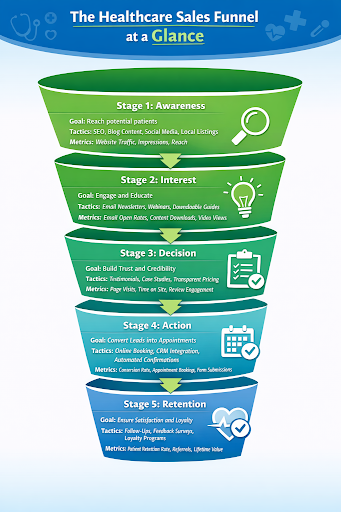
Awareness: Reaching Potential Patients
When a patient first becomes aware of a need or concern, this stage marks the beginning of their travels through the healthcare system. This is the point at which patients start seeking guidance and information, but are not yet ready to choose a provider. During this phase, the goal for healthcare practitioners is to build a presence and significance in patients’ minds.
Interest: Engaging and Educating
Once awareness is achieved, the interest stage nurtures curiosity. Patients begin evaluating whether your practice aligns with their needs. This phase benefits from educational content such as webinars, downloadable guides, or newsletters that explain treatments in accessible yet professional language. Integration of automated email sequences or chatbots can guide users through frequently asked questions, while analytics tools can identify high-engagement topics. The goal here is to deepen patient understanding while positioning your practice as a trusted, evidence-based source of information.
Decision: Building Trust and Credibility
Patients have now narrowed down their selections and are at a decision point. This is where intellectual assessment meets emotional confidence. They’ve compared credentials, read reviews, and digested information, but what they really need is confirmation that their selection feels correct. Along with choosing a provider, they are entrusting their well-being, privacy, and peace of mind to someone else. At this point, professionalism, message consistency, and ethical presentation are all subtle indicators that build trust.
Action: Converting Leads into Appointments
At the action stage, the focus shifts from persuasion to process efficiency. A patient who decides to book should encounter zero friction. Implementing an intuitive online scheduling system, quick-response forms, and automated confirmations minimizes drop-offs. Integration with CRM systems allows your team to track lead sources, ensuring timely follow-ups and personalized communication. For healthcare practices, ethical conversion also means compliance, ensuring that all touchpoints comply with privacy standards such as HIPAA or GDPR.
Retention: Ensuring Patient Satisfaction and Loyalty
In reality, the connection begins here and doesn’t really end with a visit. Mutual trust, contentment, and sustained participation are the main goals of the retention stage. Over time, patients who receive assistance and recognition often become devoted supporters, returning for further treatment and referring others to the office.
Retention is where long-term practice growth happens. According to research published by the Harvard Business Review, acquiring a new customer is 5 to 25 times more expensive than retaining an existing one. The same principle applies to patient acquisition.
Strategies for Each Funnel Stage
Utilizing SEO and Content Marketing
Effective awareness begins with strategic SEO that optimizes for local search intent, voice queries, and medical expertise keywords. Coupled with content marketing, it positions the practice as a credible educational source. Regularly publishing evidence-based blogs, patient FAQs, and condition-specific guides boosts visibility while supporting organic traffic growth.
Offering Free Resources and Consultations
How doctors can use sales funnels effectively often starts with offering free value. Offering downloadable eBooks, self-assessment tools, or short virtual consultations fosters engagement without overt selling. These actions align with patient-centered marketing ethics, giving individuals autonomy while keeping your practice top of mind.
Showcasing Testimonials and Case Studies
At this phase, social validation drives conversion. High-quality patient testimonials, anonymized outcome data, and detailed case studies communicate both competence and transparency. Video testimonials, in particular, humanize care outcomes, creating emotional resonance alongside clinical credibility.
Simplifying the Appointment Booking Process
Streamlining conversions requires removing barriers. Online scheduling integrations, one-click booking links in emails, and mobile-friendly portals improve completion rates. Synchronizing these systems with your CRM ensures immediate data capture and automated personalized responses.
Implementing Follow-Up Systems and Feedback Loops
Retention strategies define the maturity of sales funnels for doctors. Automated check-ins post-visit, annual recall reminders, and satisfaction surveys demonstrate attentiveness. Analytics dashboards can segment patient populations by engagement level, helping clinicians design customized reactivation campaigns and loyalty programs.
Tools and Technologies to Support Your Funnel
CRM Systems for Lead Management
A robust Customer Relationship Management (CRM) system centralizes patient interactions, tracks lead sources, and automates outreach. Credible platforms enable segmentation, follow-up scheduling, and data-driven performance measurement, which are essential for scaling communication ethically and efficiently.
Email Marketing Platforms
Email automation tools enable practices to nurture patients through tailored communication flows. From appointment reminders to personalized health education, automated emails maintain consistent engagement while saving administrative time.
Analytics Tools for Performance Tracking
To refine and optimize the funnel, continuous data analysis is essential. Tools like Google Analytics provide insights into patient behavior, traffic sources, and conversion rates. These metrics allow physicians to identify bottlenecks, evaluate ROI, and fine-tune marketing and operational decisions.
The Healthcare Sales Funnel at a Glance
Conclusion
Eventually, understanding how doctors can use sales funnels and applying them strategically can transform fragmented marketing into a cohesive patient-acquisition ecosystem. By aligning outreach with real patient behavior, medical professionals can foster trust, transparency, and long-term loyalty. At Your Medical Liaison, we specialize in helping healthcare practices implement intelligent, compliant, and performance-driven patient acquisition systems. From funnel design to marketing automation and analytics, our solutions empower doctors to grow ethically, engage effectively, and build thriving patient relationships in the digital age.
Frequently Asked Questions
What tools do I need to build a healthcare sales funnel?
Essential tools include a CRM system for lead management, email marketing platforms for automation, scheduling software for seamless bookings, and analytics tools like Google Analytics. These technologies streamline patient engagement and provide actionable performance insights.
How can I measure the success of my sales funnel?
Track metrics such as website traffic, conversion rates, appointment bookings, patient retention rates, and referral volume. Analytics dashboards help identify bottlenecks, optimize touchpoints, and measure ROI, enabling continuous improvement and strategic decision-making.
Can small practices benefit from sales funnels?
Absolutely. Sales funnels are scalable and adaptable to practices of all sizes. Small practices benefit from improved efficiency, better patient engagement, and measurable growth. Starting with basic automation and SEO can yield significant results without requiring large budgets.
What’s the difference between a sales funnel and traditional marketing?
Traditional marketing often focuses on one-time outreach and brand awareness. Sales funnels create a continuous, structured patient journey with measurable touchpoints at each stage. They integrate digital marketing, automation, and analytics for ongoing engagement and retention.
How long does it take to see results from a sales funnel?
Results vary based on implementation and market conditions. Initial improvements in traffic and engagement may appear within weeks, while conversion and retention gains typically manifest over several months. Consistent optimization and patient-centered strategies accelerate long-term success.
