

Have you spent heavily on advertising but still aren’t seeing the results you expected? Many physicians face this challenge because traditional advertising often reaches the wrong audience, wasting both time and money. To truly connect with patients who are actively seeking care, you need a more precise strategy. That’s where targeted marketing steps in! It allows you to connect with the right audience based on specific criteria such as location, age, gender, health interests, and online behavior. This ensures your message reaches those who are most likely to engage with your services.
In this blog, we will explain how targeted advertising works for physicians, discuss the benefits of using these ads, and tell you about the various platforms you can choose for advertising.
Targeted Advertising for Physicians: Overview
Targeted advertising helps physicians reach patients who are actively seeking relevant healthcare services by using data-driven audience segmentation based on demographics, location, interests, and online behavior. This approach improves marketing efficiency, patient acquisition, engagement, retention, and appointment bookings while reducing wasted ad spend. Platforms such as Google Ads, Meta Ads, LinkedIn, YouTube, programmatic networks, and healthcare-specific directories provide advanced targeting, measurable performance insights, and scalable opportunities to connect with the right patients at the right time.
Understanding Targeted Advertising for Physicians
Targeted advertising is a marketing strategy that focuses on reaching a specific group of people most likely to need your services. For physicians, this means connecting with potential patients based on factors such as age, medical conditions, or interests. Unlike broad, generic ads, targeted advertising ensures that your message is seen by those who are most likely to benefit from your care.
Digital platforms collect data from users’ searches, social media activity, and online engagement, which allows physicians to create highly customized campaigns. This approach not only improves patient engagement but also maximizes the return on marketing investment by reducing wasted ad spend.
This shift reflects broader patient behavior. Data from the National Cancer Institute’s Health Information National Trends Survey (HINTS) show that many individuals turn to online resources for health information, making digital channels an important touchpoint for physician visibility and patient outreach.
Benefits of Targeted Ads for Physicians
Precision Audience Targeting through Data Analytics
Modern ad platforms like Google Ads and Meta Ads Manager enable physicians to reach highly specific audiences using demographic, psychographic, and behavioral data. Through custom audience creation, ads can be shown to users based on factors such as medical interests and even search history. For example, a cardiologist can target adults over 40 who have recently searched for “heart check-up near me.” This data precision reduces irrelevant impressions, increases click-through rates, and ensures ad spend directly supports patient acquisition.
Enhanced ROI through Conversion Optimization
Digital advertising platforms provide measurable metrics like cost-per-click (CPC), conversion rate (CR), and cost-per-acquisition (CPA). Physicians can use these indicators to evaluate which campaigns generate the most appointment requests or online inquiries. Techniques such as A/B testing, conversion tracking pixels, and automated bid strategies allow campaigns to self-optimize over time, improving both lead quality and overall return on investment. This level of analytical control is impossible with traditional print or broadcast marketing.
Geographic and Demographic Relevance
For medical practices, proximity matters. Through tools like geofencing and radius targeting, physicians can limit ad visibility to patients within a defined distance from their clinic. A pediatrician might restrict visibility to families within a 10-mile radius, while an orthopedic surgeon could target middle-aged adults within specific urban or suburban zones. Combined with demographic filters such as parental status or income, this ensures ads are shown to audiences who are both relevant and local, increasing conversion likelihood.
Improved Patient Engagement and Retention
Targeted advertising helps physicians maintain strong relationships with patients after their first visit. Ads for physicians can share educational content on health conditions, promote preventive screenings, and send reminders for follow-up appointments or vaccinations. Retargeting campaigns make it possible to reach individuals who have previously interacted with the practice’s website or ads, keeping the physician’s services visible and relevant. By studying patient behavior and customizing ad messages accordingly, physicians can strengthen engagement, improve appointment consistency, and build lasting patient loyalty.
Increase appointment bookings
Multiple case studies of clinic campaigns on platforms such as Meta and Google show targeted campaigns (search + local search ads + lead forms) commonly convert at higher rates than broad display ads because they catch users when intent is high. Reports and agency case studies also document large lifts in bookings after implementing targeted search and local-service ad campaigns. Quantitative ROI varies by specialty, but sources show digital patient acquisition is measurable and scalable when campaigns are set to conversion goals.
Competitive Advantage through Data Insights
Digital advertising platforms provide in-depth analytics dashboards that go beyond clicks and impressions. Physicians can analyze user engagement trends, keyword performance, and conversion attribution to identify what drives patient action. For instance, a dermatologist may find higher engagement with ads promoting acne treatments among users aged 18–30, leading to data-backed adjustments in campaign strategy. These insights not only improve ad efficiency but also help practices anticipate seasonal or regional shifts in healthcare demand, providing a measurable competitive edge.
Discover targeted advertising strategies designed to help physicians connect with qualified patients actively searching for care.
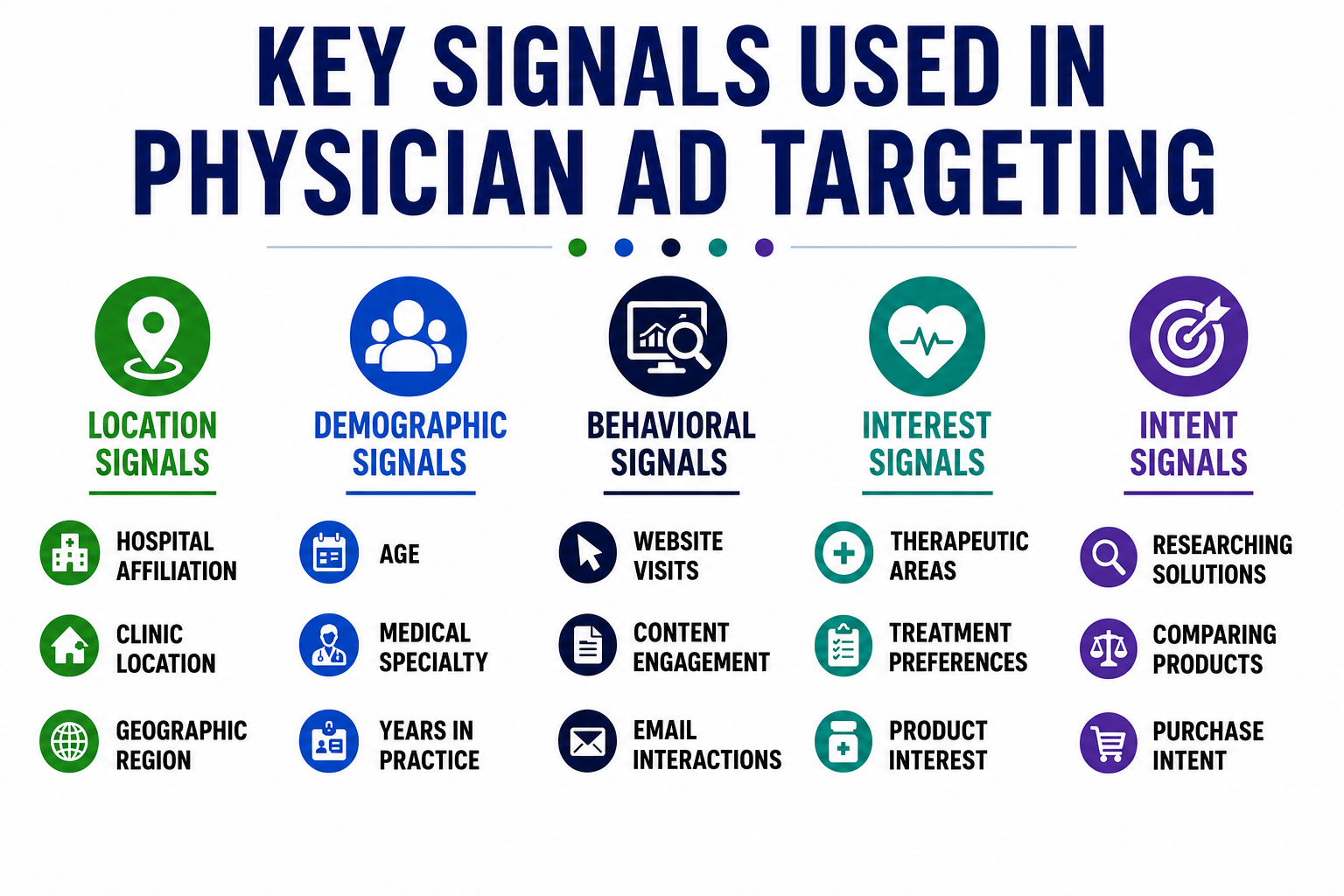
Key Signals Used in Physician Ad Targeting
Understanding how targeted advertising works begins with knowing the data points that help platforms identify potential patients. Rather than displaying ads to a broad audience, modern advertising systems analyze multiple indicators to determine which individuals are most likely to engage with a physician’s services, making outreach more relevant and efficient.
Key Platforms for Targeted Advertising
Google Ads
Through Google Ads, physicians can engage patients with high intent by leveraging tools like Search, Display, and Performance Max campaigns. Key functionalities such as keyword targeting, geographic filters, and conversion tracking ensure services are shown to the most relevant audience. The integration with Google My Business boosts local visibility, while the automation powered by AI optimizes budgets for a better return on investment.
Meta Ads (Facebook & Instagram)
Meta Ads provide advanced demographic and behavioral targeting, leveraging parameters such as device type, engagement history, and life events. Physicians can use Custom Audiences and Lookalike Audiences to find similar user groups. Lead Generation Ads help capture inquiries directly within the platform, and geo-fencing tools support location-specific marketing under healthcare compliance.
LinkedIn Ads
For those in the B2B healthcare space, LinkedIn Ads stand out. It’s the ideal platform for physicians looking to build partnerships or engage with corporate clients in fields like occupational health or telemedicine. Filters allow precise targeting based on industry, job title, or company size. Sponsored Content and InMail campaigns help in establishing thought leadership and strengthening credibility within professional circles.
YouTube Ads
When it comes to educational content, YouTube Ads offer a dynamic platform for physicians to raise awareness through video. By utilizing formats such as TrueView and In-Stream ads, physicians can target health-conscious viewers already watching related content. The value of video-based outreach is reinforced by Pew Research Center findings showing that YouTube remains one of the most widely used online platforms, creating significant opportunities for physicians to educate and engage healthcare consumers through video content. Integration with Google Analytics allows for detailed campaign performance tracking, helping to refine messaging based on metrics like view duration, engagement, and conversion rates.
Programmatic Advertising
Programmatic advertising takes a high-tech approach to audience targeting by utilizing real-time bidding (RTB) across a wide range of websites and devices. Using demand-side platforms (DSPs), physicians can connect with potential patients based on their browsing history, demographics, and interactions with healthcare-related content. With predictive audience modeling and cross-device targeting, programmatic ads ensure that campaigns are not only highly precise but also expansive.
Healthcare-Specific Platforms
Platforms dedicated to healthcare, like Healthgrades, Zocdoc, and Practo, serve as effective touchpoints for physicians to engage directly with patients actively seeking healthcare services. These platforms offer sponsored listings, verified reviews, and integration with booking systems to boost visibility and simplify the patient’s journey. Since they comply with healthcare advertising regulations, these platforms also ensure that campaigns are compliant and trustworthy.
Conclusion
Reaching the right patients requires strategy and the right support. If you are looking for a trusted platform to guide you, Your Medical Liaison will help you build effective digital campaigns that align with your practice goals and patient needs. Our data-driven approach focuses on audience insights, platform optimization, and compliance with healthcare advertising standards to help physicians achieve measurable growth and stronger patient engagement.
To attract more of the right patients through targeted advertising, get a whole new customized patient acquisition strategy for your practice with us.
Frequently Asked Questions About Physician Targeted Ads
1. How can physicians identify the ideal patient profile before launching targeted ads?
Physicians can analyze their most profitable and frequently treated patient groups to define an ideal audience profile.
2. Can targeted ads help physicians attract more self-pay patients?
Yes, targeted campaigns can focus on audiences interested in elective, preventive, or cash-pay healthcare services.
3. How can physicians balance patient acquisition and practice capacity when running targeted ads?
Physicians should align campaign volume with appointment availability to maintain a positive patient experience.
4. Can targeted advertising support the launch of a new medical procedure or specialty service?
Yes, targeted campaigns can introduce new services to patients most likely to benefit from them.
5. How can physicians use targeted ads to improve referral-network visibility?
Targeted campaigns can increase awareness among patients and healthcare professionals seeking specialized care options.
6. What factors should physicians consider before expanding targeted advertising to new service areas?
Patient demand, competition, travel accessibility, and operational capacity should be evaluated before expansion.
