

As a healthcare professional, whether you work in a clinic or have your own practice, building an online brand is crucial to success. Among a sea of healthcare platforms, LinkedIn provides the deliberate exposure you are looking for! Each time your name pops up, each time someone says something about you, each time someone visits your LinkedIn page, a perception is being formed.
Unfortunately, you may be among those healthcare workers who do not complete their profile or share content sporadically enough that the message becomes unclear. The end result is you ending up with an online presence that fails to perform. This guide breaks down LinkedIn marketing for healthcare professionals in a way that feels natural and is built specifically for your niche.
Overview: Establishing Medical Authority on LinkedInAt present, LinkedIn is not only an online networking site but also the place where healthcare providers create their own reputation outside the confines of the clinical office environment. This platform, when used strategically, allows you to showcase your knowledge, interact with like-minded colleagues and healthcare service providers, and keep yourself constantly visible without stepping out of the professional line. Over time, this consistent presence can translate into stronger referrals, valuable collaborations, and new career opportunities. |
Why LinkedIn Is the Place Where Healthcare Professionals Build Brand Authority
The Need For Personal Branding in Healthcare
Consider all those whose professional lives intersect with yours in the medical world. This includes those who can refer you, those you can work with, and those who can influence decisions on your behalf. They’re all already on LinkedIn, and you are free to access them in any way:
- Other Physicians & Specialists: Grow your referral network and find research partners within different specialties.
- Researchers & Academia: Stay updated with new research and trials in clinical studies.
- Hospital Admins & Executives: Get in front of the people making decisions that shape the industry.
- Pharma & Med-Tech Companies: Keep up with innovations and open doors to industry partnerships.
- Recruiters & Career Opportunities: Let the right people find you when the right role comes along.
- Patients & the Public: Have your expertise speak before they ever book an appointment.
And the impact is real. A PubMed study out of Washington University School of Medicine found that physicians active on social media gain direct opportunities in public health, medical education, and scientific collaboration. In practice, that means speaking invitations, referral partnerships, and leadership roles. This kind of visibility that word-of-mouth alone simply can’t build at scale.
Why LinkedIn Outperforms Other Platforms for Clinicians
There is an appropriate social network for each use case, but LinkedIn is the only one designed completely on the concept of trust. Here, your qualifications, specialty, experience, and opinions matter the most. Where X and Instagram networks can be quite noisy, LinkedIn is a credible network where the relevant audience listens.
Yet a PMC study found that while 61.6% of physicians knew LinkedIn could advance their careers, 74% still didn’t have or actively use a professional account. With less competition, a highly targeted audience, and a platform built for credibility, yet most healthcare professionals are still sitting it out.
At the end of the day, this platform is where your investment pays off most directly in healthcare. This is evident in stronger referral networks, deeper peer connections, and a professional presence that works for you even when you’re focused entirely on patient care.
How to Build a Brand on LinkedIn as a Healthcare Professional
Posting With Purpose: What Works for Healthcare Professionals
The posts that hook people are not service announcements; they’re the ones only you, a healthcare professional, could write. Conversations like the diagnosis that didn’t follow the textbook, the patient’s question that shifted how you explain something, and the treatment debate your colleagues haven’t settled matter. This is the core of what effective LinkedIn marketing for doctors like you looks like: clinical insight, shared consistently, with a specific audience in mind. Lead with a real clinical observation, keep it direct, and post two to three times a week. Specificity beats volume every time!
Who to Connect With Without Feeling Like a Salesperson
Search LinkedIn for healthcare service providers and hospital executives in your city; there are more than you’d expect. Send two to three requests a week with a genuine, specific note. Comment on their posts before you ever message them directly. In LinkedIn marketing for healthcare professionals, relationships built this way follow the same logic as physician liaison work: consistent, value-first contact that earns trust before asking for anything.
Visually Sharing What You Know That Builds Authority
A two-minute video answering a question your patients ask every week will outperform most static text posts. An infographic breaking down a diagnosis, a carousel walking through a procedure, a simple visual explaining how a treatment works: these stop people mid-scroll in a way plain text rarely does. According to a survey study published in JAMA Network Open, nearly 4 in 10 physicians reported that social media use directly resulted in a speaking engagement, while nearly half said it expanded their research portfolio.
The Right LinkedIn Groups Are Worth the Search
Skip the broad, generic groups and look specifically for communities around your specialty, functional and integrative medicine, or healthcare leadership. The value isn’t passive; it comes from actually participating. A pointed comment on a clinical debate, a question rooted in your real practice experience, a perspective others haven’t considered. That’s what builds visibility with the people who matter most in your field.
Protecting Your Reputation While Staying Visible
Being on a public platform means anyone can find you: a potential patient, a referring physician, a recruiter, or even a journalist. That’s mostly a good thing. But it does mean your reputation isn’t just built in the clinic anymore; it lives online too. A few habits that keep it in good shape:
- Keep your profile current: An outdated profile quietly signals inactivity, and inactivity signals irrelevance.
- Respond professionally, always: How you show up in the comments says just as much as what you post.
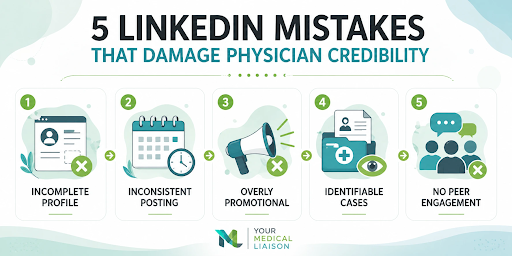
- Share perspectives, not cases: While your clinical insights are gold, identifiable patient details are a liability.
Here’s a summed-up look at the possible mistakes you can make, so you know what to avoid:
Conclusion
Knowing what to do on LinkedIn and actually doing it consistently are two very different things. Most healthcare workers simply don’t have the bandwidth to build a compelling presence while managing patient care.
On the other hand, the healthcare professionals who show up most powerfully on LinkedIn aren’t doing it alone. At Your Medical Liaison, we’ve worked exclusively with healthcare professionals and integrative providers since 2012, translating your clinical expertise into content that builds authority and grows your practice while you focus on medicine.
Let’s build the LinkedIn presence your expertise deserves! Book your consultation today.
FAQs
Does LinkedIn marketing for doctors actually influence physician referral decisions?
Referring physicians increasingly look up colleagues online before sending cases, and your LinkedIn profile is often the first thing they find. A presence that clearly communicates your specialty and clinical perspective makes referral decisions easier and keeps you top of mind when a relevant case comes up.
Will posting medical content put me at legal or professional risk?
As long as you share clinical insights rather than identifiable patient details, you remain well within HIPAA guidelines. The key distinction is discussing conditions or treatment approaches in general terms versus anything that could identify a specific patient.
Is LinkedIn marketing worth it for specialists?
For specialists, LinkedIn is particularly effective because niche expertise stands out in a less crowded, more targeted feed. The more defined your specialty, the easier it is to build a reputation that travels well beyond your immediate geographic area.
What’s the difference between a general and healthcare-specific marketing agency?
A general agency spends a significant portion of its budget learning your field: the terminology, compliance landscape, and how medical professionals communicate. A healthcare-specific agency already understands that context, which means the work is faster, more accurate, and more credible from day one.
How long before LinkedIn marketing for healthcare professionals shows real results?
Most physicians begin seeing meaningful traction: profile views, relevant connection requests, and inbound messages, within three to six months of consistent activity. Physicians who combine regular content with genuine community engagement tend to see results on the shorter end of that window.
Is a marketing agency worth it for smaller practices?
For smaller practices, even a modest increase in referrals can meaningfully impact patient volume, making the return on investment faster than most expect. In many cases, a single strong referral relationship built through LinkedIn can generate more revenue than the cost of the service itself.
