

When patients need a healthcare provider today, their first instinct is to search online, compare reviews, and form opinions within minutes. But managing this perception consistently is not as simple as it seems. From handling negative feedback to building trust through authentic patient experiences, healthcare providers face growing challenges online. This is where reputation management companies play a crucial role, helping healthcare providers maintain a strong and consistent digital image across all platforms.
As a healthcare facility, it is necessary to factor in this resource, but before that lets explore how online healthcare reputation management influences patient decisions.
Healthcare Reputation Management OverviewOnline reputation management in healthcare shapes how patients perceive and choose providers by influencing trust, credibility, and decision-making. A consistent digital presence, positive patient experiences, and transparent communication reduce uncertainty and build confidence. Strategic use of sentiment analysis, compliance-driven responses, and accurate listings strengthens authority. Effectively managing reviews—both positive and negative—helps healthcare organizations maintain reliability, improve patient engagement, and drive sustainable growth in an increasingly digital-first healthcare environment. |
What Is Online Reputation Management in Healthcare?
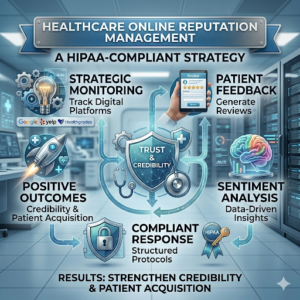
Online healthcare reputation management is a HIPAA-compliant, strategic approach to tracking and shaping how a medical practice’s online reputation is perceived across search engines, review sites, and patient feedback systems. It includes creating reviews, conducting sentiment analysis, and instituting systemic response measures to ensure compliance and trust. With data-driven insights and regulated communication models, healthcare organizations can ensure accurate representation, enhance credibility, and achieve consistent patient acquisition outcomes.
How Online Reputation Management Helps Healthcare Facilities
Builds Patient Trust & Credibility
In health care, the development of trust begins long before a patient sets foot in the door. The first layer of credibility is online reviews, ratings, and visible interactions. A provider who is always clear and professional in responding to feedback demonstrates transparency and accountability. This initial reassurance reduces uncertainty and fosters confidence, so patients feel less hesitant to contact care providers.
Influences Patient Decision-Making
When trust is established, patients embark on making comparisons. At this point, reputation becomes a determinant rather than a supporting factor. Good ratings, recent reviews, and accurate profiles help patients make judgments about quality and reliability in short timeframes. A medical practice’s online reputation will help the provider shine through in this crucial selection process.
Increases Patient Acquisition & Revenue
The reputation can be directly converted into quantifiable business results. A favorable view promotes more inquiries, increased appointment conversions, and enhanced patient retention. Repeated exposure to positive feedback and regular interaction with patients increases the likelihood that patients will use the facility and refer others to it, with long-term effects on patient volume and revenue.
Improves Search Engine Visibility
Online reputation has a more significant influence on discoverability than patient perception. Search engines prioritize healthcare providers that show activity, provide updates, and signal positive reviews. This improves ranking in local search results, making the facility visible whenever potential patients are actively searching for services.
Strategies to Improve Online Reputation for Healthcare Providers
Implement Structured Review Generation Systems
An endless stream of legitimate reviews does not occur accidentally; it requires a mechanism. With automated follow-ups incorporated into the patient journey, providers will be able to consistently collect feedback without manual effort. This systematic technique provides a sustained and balanced review profile that reflects actual patient experiences over the long run.
Establish Reputation Response Protocols
The reaction of a provider to the feedback is as likely to influence the perception of the people as the feedback. Established response guidelines equate to consistency of tone, speed and message. Not only is that a sign of professionalism, but it also indicates that the patient’s concerns are heard and addressed responsibly.
Ensure NAP Consistency Across Digital Ecosystem
Stability in business information is a prerequisite for credibility. Name, Address, or Phone differences between platforms can be confusing to patients and search engines. Having consistent data across directories and listings also makes them more dependable and helps enhance local search.
Develop Authority-Driven Medical Content Strategy
Content does not serve the same purpose as reviews- it develops competence and not confirmation. Correct, well-organized medical information, when published, will help position the provider as an informed authority. This enhances patient trust by providing them with value beyond services, particularly during the research stage of their journey.
Deploy Continuous Brand Monitoring Systems
Reputation does not exist in a vacuum; it changes with each patient encounter and each mention online. Constant follow-up enables the providers to monitor sentiment, analyze emerging issues, and proactively address them. This ensures that problems are tackled at the first stage before they can develop and that a positive brand image is maintained at all times.
Why Patients Trust Online Reviews When Choosing Healthcare Providers
How Positive Reviews Build Patient Confidence
The consistent availability of high-quality patient experiences indicates reliability and clinical competence. It reduces uncertainty and enhances confidence in personal choices when people observe others’ detailed, recent experiences. This observable confirmation serves as social proof and makes patients feel safer when choosing a provider who has not undergone extensive offline verification.
The Impact of Negative Reviews on Healthcare Providers
Salient, unfavorable experiences can have a significant impact by raising awareness of potential dangers. Patients tend to interpret recurring issues as systemic problems rather than singular events. This may lead to indecision or to giving up on the decision-making process, particularly when rival providers offer a more stable digital image.
Responding to Reviews: A Key Part of Reputation Management
Operational transparency and accountability are evidenced by involvement in publicly visible patient experiences. A professional approach to the response is structured and demonstrates a provider’s intention to address concerns and uphold service standards. It also helps inform potential patients that the practice is proactively managing its online presence, which, in turn, builds trust by demonstrating responsiveness rather than passivity.
Conclusion
Reputation management in a data-driven healthcare setting needs to go beyond visibility and include accuracy, automation, and performance measurement. Your Medical Liaison provides cutting-edge solutions based on real-time data tracking, workflow automation, and performance analytics tailored to medical practice. We facilitate the integration of technology within well-organized processes so that providers can streamline operations, position themselves in the market, and promote sustainable patient growth without adding complexity, healthcare branding services.
Take control of your digital reputation today—partner with Your Medical Liaison to transform your online presence into a powerful driver of patient acquisition and long-term success.
FAQs
Does online reputation have an impact on patient retention?
Yes, a robust and stable digital picture enhances trust in continuous care and makes patients think of continuing their treatment with the same provider in the long run.
What is the effect of digital trust on patient behavior?
Online trust also minimizes indecisions and can make patients more confident in choosing a provider, particularly in the case of first-time healthcare choices (or a decision) made on the basis of online research.
How can healthcare listings play a role in patient choice?
Healthcare listings are the primary point of reference where patients compare providers, review information, and form initial impressions before visiting a clinic or hospital.
What is the impact of online credibility on first-time patients?
Online credibility cues are the most important to first-time patients seeking to minimize risk and feel confident about selecting a healthcare provider they do not know.
What is the difference between Your Medical Liaison and the conventional marketing agencies?
It specifically addresses healthcare systems, integrating compliance-based approaches with data-driven reputation tracking designed for medical professionals.
