
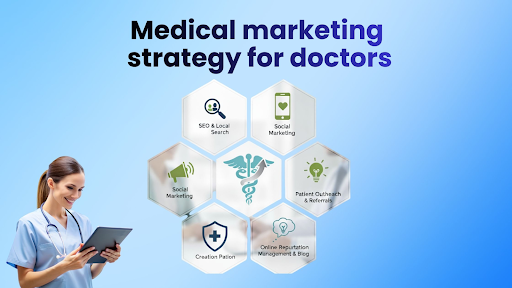
If your current healthcare digital marketing strategy is a black hole of spend with zero patient growth, then you’re not alone. Most clinical practices still use traditional digital marketing strategies in the modern world of medicine, and the two are as different as night and day. While traditional marketing focuses on “interruption” marketing and visibility, modern healthcare marketing centers on clinical intent and YMYL (your money or your life) authority. Instead of an ad, patients expect a seamless, HIPAA-compliant experience from their first symptom-based search to their first appointment. To truly grow a scalable digital marketing strategy, you must move beyond “clicks” and master the specialized world of medical SEO, generative search, and patient funnel marketing.
Therefore, we bring you this resource that equips you with the knowledge of modern strategies needed and helps bridge the gap. Let’s get started!
Key Takeaways
|
Healthcare Brand Strategy & Positioning
What It Is
In the field of medicine, if you try to be everything to everyone, you become a commodity. Here, branding and strategic positioning help you move to a “specialized authority.” For autoimmune and integrative medicine practices, this means anchoring your brand to specific conditions, such as Hashimoto’s thyroiditis, rheumatoid arthritis, or lupus, so patients searching for those conditions find you first. It’s about picking a lane so patients know exactly why you’re the right choice over other competitors, which is precisely what your Unique Value Proposition (UVP) is.
Core Services & Benefits
- Messaging Frameworks: This involves stripping away cold jargon. For instance, rather than saying “autoimmune intervention protocols,” a practice can speak directly to patients by saying, “helping you reduce flares and reclaim your energy.” This outcome-led language resonates with autoimmune patients who are navigating the frustration of invisible illness and a complex diagnostic journey.
- Authority Signals: Emphasizing board certifications and research is essential in establishing authority for functional and integrative medicine brands, as it gives patients the evidence-based support they need to feel secure. Moreover, every piece of content should include a licensed author byline, a clinical review date, NPI schema markup, and links to peer-reviewed sources to satisfy Google’s elevated YMYL scrutiny for autoimmune and medical content.
- Differentiation: Clear healthcare brand positioning ensures a clinic’s specific “image”, like a quiet, low-wait, concierge model, is immediately obvious. This prevents patient mismatch and builds long-term loyalty before the first co-pay is even made. The recommended UVP positioning for an autoimmune-focused practice is: “Specialised care for autoimmune conditions, evidence-based, practitioner-led, and built around your daily life.”
Healthcare Website Design & Development
What It Is
A medical website serves as a digital front door to your clinical care. It is a specialized environment where healthcare website design principles are used to guide anxious users toward the right solutions. Thus, a website for a medical practice goes beyond a simple layout; it is about creating a “low-friction” experience where a person in need can find a provider and book a visit in under three clicks, regardless of the device they use.
Fun Fact!According to a study published in the Journal of Medical Internet Research [1], a healthcare website that takes longer than 3 seconds to load on mobile loses approximately 53% of its users. |
Core Services & Benefits
- Privacy Patients Can Trust: By addressing HIPAA [2] considerations in website design, the site ensures that personal health data stays encrypted and secure. This builds immediate peace of mind for the patient, as they can see their information is safe.
- Instant Credibility: Incorporating website trust factors for medical practices, such as doctor profiles and patient reviews, will establish your credibility. This is because you are showing the human side of your healthcare facility, making patients feel as though they already know you before they even set foot in your office. Adding NPI schema markup and structured data (MedicalClinic, FAQPage) is equally critical; without it, Google and generative AI engines will de-prioritise your content as unverified.
- Seamless Booking: You can make it easy for patients to get in touch by avoiding common UX pitfalls on healthcare sites. Online scheduling, for instance, enables patients to schedule appointments at any time, not just when your office is open. Here is a closer look at the most common mistakes on sites :
Common UX Mistakes on Medical Practice Websites
|
Search Engine Optimization for Healthcare Providers
What It Is
One way you can secure organic visibility across Google and generative engines is through medical SEO. Unlike general SEO, it operates under YMYL search rules that hold medical content to a higher standard of accuracy and trust. Thus, when patients search for a diagnosis, they find qualified professionals through a strategic mix of local, informational, and authority-based SEO, filtering out unverified sources.
Core Services & Benefits
- Local Patient Acquisition: Improving local SEO strategies for medical clinics and doctors helps them rank at the top of “near me” searches. This guarantees that their office hours, location, and patient reviews are the first thing that a neighbor will see in their time of need.
- Answering Real Patient Questions: Using medical keyword intent mapping ensures you show up when someone searches “fatigue after eating with autoimmune disease” or “joint pain lupus flare,” not just broad terms like “autoimmune specialist.” Content should anchor to named conditions — Hashimoto’s, rheumatoid arthritis, MS — so search engines can establish topical authority for your specific niche.
- Proving Clinical Trust: Medical practices show search engines they are safe and reliable by building E-E-A-T and healthcare content trust signals. This is a vital step because the healthcare industry faces much stricter scrutiny than other businesses. It’s about proving that the advice on the site comes from a qualified, professional source.
Common Mistakes You Can Avoid
|
Paid Advertising for Healthcare Practices
What It Is
Paid advertising is a way to get your practice’s name in front of patients immediately. Ads on intent-based channels like Google and Facebook appear the moment someone searches for a specific treatment. The goal is to use landing page optimization to convert those clicks into office visits, while reducing the cost per lead so the marketing budget is spent effectively.
Core Services & Benefits
- Showing Up the Moment Help is Needed: Intent-based Google Ads places a practice at the top of the page at the moment a patient is searching for urgent care or a specialist. If you follow the Google Ads policies made for healthcare businesses, you can make sure that your campaigns are professional and compliant.
- Building Connections on Social Media: Strategic use of Meta and social media advertising can reach a defined audience with educational content. The objective is to know how to generate qualified patient leads with paid ads, not by pushing aggressive sales tactics, but by focusing on clinical value and privacy.
- Creating a Smooth Path to Care: Optimizing landing pages for healthcare ads is a significant part of any campaign. This ensures that if a patient clicks on any ad, they can easily and securely get to a page. Landing pages must include transparent, HIPAA-aware content and avoid unrealistic outcome claims to prevent ad disapprovals and protect your practice’s compliance standing.
Social Media Marketing for Healthcare Brands
What It Is
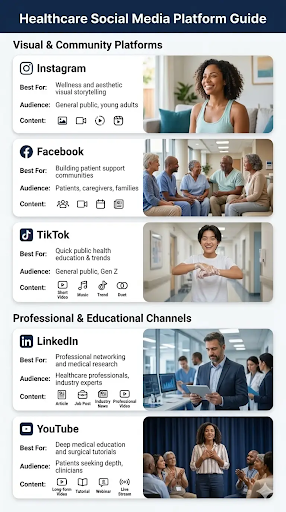
Social media marketing in healthcare is the strategic use of platforms like Instagram, Facebook, and LinkedIn to build professional credibility and patient trust. It serves as a digital extension of your healthcare practice’s personality, providing a space to educate the public and engage with the local community while strictly adhering to privacy and compliance standards.
Core Services & Benefits
- Patient Education & Awareness: Complex health issues are broken down into easy-to-understand content. This way, a healthcare facility can debunk common myths and subsequently alleviate patients’ fears and worries.
- Clinical Humanization: By featuring the staff and the “behind the scenes” of the practice, the brand becomes more relatable and human. This provides an additional level of comfort and familiarity before the patient even walks into the office.
- Compliance & Risk Management: Care must be taken to ensure that all social media activities comply with HIPAA [2]. This includes obtaining written consent for patient stories and avoiding the sharing of any protected health information (PHI) [3].
Sales Funnels & Patient Journey Optimization
What It Is
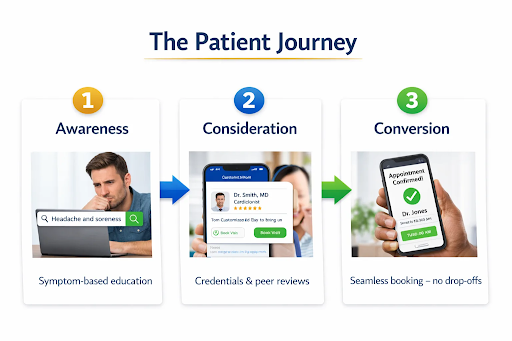
Patient journey optimization is the process of mapping the digital path a person takes from their first symptom to their first appointment. In healthcare, a “sales funnel” isn’t a transaction; it is a structured clinical pathway designed to replace the “leaky” traditional website with a guided experience that answers specific patient anxieties and removes technical friction.
Core Services & Benefits
- Decision-Phase Alignment: Journeys are engineered for specific medical intents, with these stages:
- Awareness stages provide symptom-based education
- Consideration stages highlight credentials and peer reviews
- Conversion stages focus on a seamless booking process to prevent drop-offs
- Specialty-Specific Funnel Design: Digital healthcare agencies design high-speed, “near-me” funnels for urgent care to capture immediate needs, and longer, high-touch nurturing sequences for elective procedures (like aesthetics or orthopedic surgery) where patients require more evidence before committing.
- Clinical Performance Metrics: Success is measured by the practice’s health, not just traffic. Agencies nurture leads by tracking Cost Per Acquisition (CPA) and lead response time to pinpoint where potential patients are dropping off, enabling real-time adjustments to your marketing ROI.
Video Content & Visual Authority Building
What It Is
Video content is used as a clinical communication tool to convert complex medical data into accessible visual narratives. It serves as a bridge between a provider’s technical expertise and a patient’s need for clarity, replacing static text with high-retention formats such as procedure walkthroughs, physician introductions, and patient stories.
Core Services & Benefits
- Strategic Clinical Education: Videos are engineered to simplify high-stakes procedures. By using explainer videos and anatomical animations, your healthcare practice can address frequently asked questions and clarify recovery expectations.
- Humanization & Trust Building: Doctor-led content and facility tours help patients see the team and the technology in action. This helps build rapport and professional credibility.
- Social Proof & Conversion: Patient Testimonials provide authentic, visual evidence of successful outcomes. These stories act as powerful social proof that written reviews cannot match when paired with clear Calls-to-Action (CTA).
- Video SEO & Accessibility: Every asset should be optimized for discovery on YouTube and Google. This can be achieved by incorporating keyword-rich titles and closed captions.
Integrated Healthcare Digital Marketing Strategy
What It Is
An integrated strategy coordinates every digital touchpoint into a cohesive unit. Running SEO, social media, and paid ads as separate efforts is a costly mistake that leads to fragmented messaging. A unified strategy ensures all platforms work together, guiding a patient from their first search to a final consultation.
Core Services & Benefits
- Omnichannel Visibility & The Content Loop: Multi-channel marketing connects search, social, and email into one journey. High-quality content is repurposed, a single video becomes an SEO blog, a social clip, and an email feature. This ensures every channel reinforces the next, your SEO feeds your ads, your ads feed your funnels, and your funnels drive bookings
- Data-Driven Optimization: This replaces vanity metrics with indicators like patient acquisition cost (PAC) and customer lifetime value (CLV). Using a HIPAA-compliant [2] CRM creates a shared data layer, connecting digital clicks to physical office arrivals to ensure high-ROI investing.
- Automated Nurturing: Systems trigger follow-ups automatically. If a lead engages with an ad, the integrated system sends personalized education via email, keeping your medical office top-of-mind without manual staff effort.
Generative Engine Optimization for Healthcare Content
GEO is the necessary infrastructure for any medical brand aiming to stay visible. It functions as a verification layer, ensuring that when an AI “crawls” the web, it finds a medical practice’s NPI [4] (National Provider Identifier) and clinical expertise ready for citation. The absence of GEO infrastructure means the practice remains invisible in AI-generated health responses — a critical gap as generative search becomes the dominant way patients find care. It has 3 pillars:
- Pillar 1: Clinical Citation Strength. A focus on generative search visibility ensures that a clinic’s specific treatment protocols are pulled directly into AI-powered patient responses. This requires clinical citation anchors, direct-answer paragraphs that AI can extract and cite.
- Pillar 2: Data Clarity for Diagnosis. Utilizing entity optimization allows you to define the practice’s clinical scope by linking symptoms directly to the healthcare facility’s solutions. For instance, named conditions (Hashimoto’s, rheumatoid arthritis, MS) must be explicitly linked to treatments so AI engines can map the practice’s expertise.
- Pillar 3: Content Longevity & E-E-A-T. Transitioning to AI-ready healthcare content ensures that medical articles remain “cite-able” by proving to the AI that the information is medically sound and authored by experts. Adding FAQPage schema and structured entity links is the implementation mechanism for this pillar.
Trust, Compliance & Ethical Marketing
In healthcare, digital trust is the foundation of patient volume. Under this foundation, compliance acts as the technical and legal safeguard for a practice’s medical license. This framework ensures that data handling meets federal standards and that marketing remains clinically honest. Here’s a breakdown of the core compliance standards you need to understand:
| The Standard | What it actually is | Why it matters for your practice |
| The BAA (Business Associate Agreement) [5] | A legal “handshake” between you and your tech tools (like your customer relationship provider or email provider). | It forces the tech company to take legal responsibility for data safety, so the weight isn’t all on your shoulders. |
| Pixel Privacy Cleaning | Stripping out sensitive patient details (like what they searched for) before data hits Facebook or Google. | It keeps patient health secrets off social media and protects your healthcare business from “privacy leak” lawsuits. |
| The YMYL Quality Bar | A “truth-in-advertising” test that search engines use for medical websites. | It ensures your expertise is recognized as a “Gold Standard” source, keeping your site visible and respected by algorithms. |
| Digital Open Doors (WCAG) [6] | Making your website easy to use for people with vision or hearing impairments. | It makes sure every patient, regardless of their physical ability, can book an appointment without frustration or legal barriers. |
| The Digital ID (NPI Schema) [4] | A piece of code that proves a board-certified human wrote your content. | It tells AI and search engines: “This isn’t a bot talking; this is a licensed doctor,” which is the ultimate trust signal. |
| Permission-First Contact | Following the rules for how and when you can text or email a patient. | It ensures you’re never “that doctor” who spams patients, keeping your communication professional and legally safe. |
Conclusion
Every day without a digital strategy, the right patients find someone else, whether it’s because of a missed review, a slow website, or an untracked ad spend quietly draining your budget. It adds up faster than most doctors and clinics realize, and the harder truth is that you cannot manage each strategy alone. For autoimmune and integrative medicine practices specifically, the cost is compounded: patients searching for condition-specific care will find a competitor who has invested in symptom-level SEO, schema markup, and GEO infrastructure. That’s exactly why Your Medical Liaison exists. Since 2012, we have helped physicians and functional and integrative providers grow their practices through education, transparency, and patient-first marketing.
Book a free marketing checkup today and start growing your healthcare facility’s online presence!
Citations
[1] Fundingsland EL Jr, Fike J, Calvano J, Beach J, Lai D, He S. Methodological Guidelines for Systematic Assessments of Health Care Websites Using Web Analytics: Tutorial. J Med Internet Res. 2022 Apr 15;24(4):e28291. doi: 10.2196/28291. PMID: 35436216; PMCID: PMC9055485.
[2] Health Insurance Portability and Accountability Act of 1996 (HIPAA).” CDC, Centers for Disease Control and Prevention, www.cdc.gov/phlp/php/resources/health-insurance-portability-and-accountability-act-of-1996-hipaa.html
[3] Isola S, Al Khalili Y. Protected Health Information. [Updated 2023 Jan 30]. In: StatPearls [Internet]. Treasure Island (FL): StatPearls Publishing; 2026 Jan-. Available from: https://www.ncbi.nlm.nih.gov/books/NBK553131/
[4] Centers for Medicare & Medicaid Services. (n.d.). National Provider Identifier standard (NPI). U.S. Department of Health and Human Services. https://www.cms.gov/regulations-and-guidance/administrative-simplification/nationalprovidentstand
[5] U.S. Department of Health & Human Services. (n.d.). Sample business associate agreement provisions. HHS.gov. https://www.hhs.gov/hipaa/for-professionals/covered-entities/sample-business-associate-agreement-provisions/index.html
[6] Our accessibility standard is based on the W3C’s Web Content Accessibility Guidelines (WCAG) 2.2, a W3C Recommendation published 11 December 2024 (latest version at https://www.w3.org/TR/WCAG22/).”
FAQs
How long does SEO realistically take to generate patient appointments for my medical practice?
You can expect four to six months for traction, with consistent appointment-driven results closer to twelve months.
Which digital channels bring the highest-intent patients, and not just traffic, to my clinic?
Google Search and local SEO capture patients actively searching for solutions, delivering the highest conversion rates, every time.
Why do my Google Ads for healthcare keep getting disapproved, and how can my practices stay compliant?
Usually, ads on Google get removed due to targeting sensitive conditions or unrealistic outcome claims. Transparent, HIPAA-aware landing pages resolve most disapprovals.
Why do patients leave my healthcare website without booking, even if my services are good?
Patients usually leave not because your services aren’t good, but because the website feels slow, confusing, or hard to trust, and if booking isn’t quick and obvious, they simply move on.
What is the ideal balance between SEO and paid ads for my medical practice?
The ideal balance is using paid ads for immediate patient acquisition while building SEO for sustainable, long-term appointment growth and lower cost per acquisition over time.
