
In 2026, medical practices face different challenges when trying to appear in search results. An SEO strategy that works for a restaurant, online store, or home service business may not work the same way for healthcare, where search results can influence decisions about treatment and care. Medical websites need accurate information, clear expertise, trustworthy content, strong local visibility, and a helpful experience for patients. They also need to consider healthcare-specific privacy and security requirements. These extra factors make medical SEO different from standard SEO.
This blog explains the key differences and the areas of SEO for medical practices that you should focus on to build search visibility while earning patient trust.
Medical SEO: Trust-Driven Digital StrategyHealthcare SEO differs from standard SEO due to YMYL classification, requiring accuracy, verifiable clinical expertise, and ethical conversion practices over aggressive marketing. Success depends on visible author credentials, HIPAA-compliant analytics, genuine content freshness, and original medical knowledge bases created by real practitioners. Structured data must match actual page content, and practices should track AI-generated search visibility alongside traditional traffic. Reputation management carries higher stakes in healthcare, since patient trust directly influences treatment decisions, making authoritative, compliant, patient-friendly websites essential for sustainable practice growth. |
Why Healthcare SEO Requires a Different Approach Than Traditional SEO?
Healthcare Content is Classified as YMYL by Google
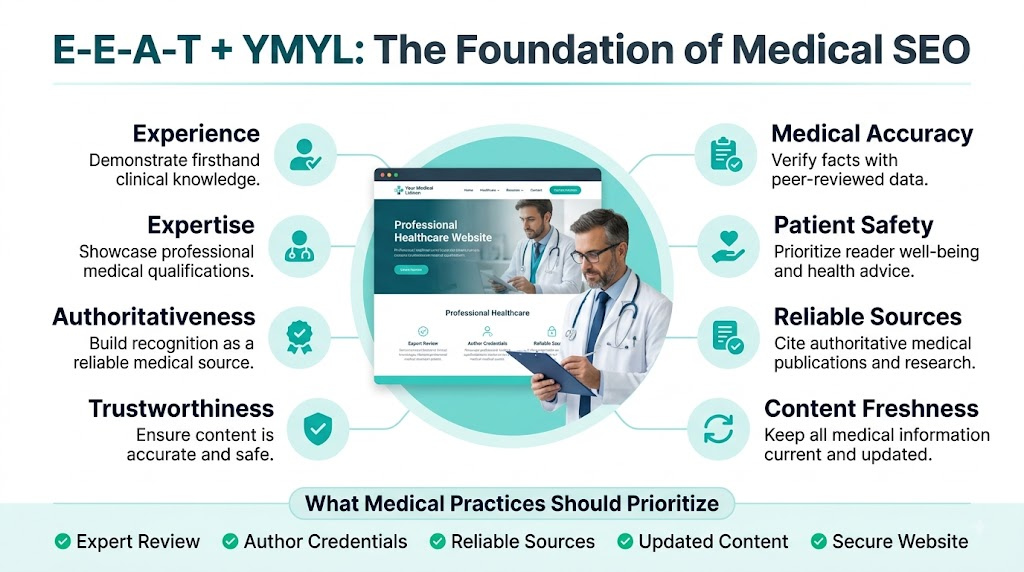
Google considers topics that can significantly affect people’s health, safety, financial stability, or well-being to be “Your Money or Your Life” (YMYL) topics. Google’s guidance on creating helpful, reliable, people-first content [1] explains that its systems place greater emphasis on strong E-E-A-T for topics that can significantly affect people’s health or safety. This means healthcare content should prioritize accurate, reliable, and trustworthy information. As a result, medical SEO marketing requires a careful, accuracy-first approach that focuses on building search visibility without compromising patient trust.
Clinical Expertise Must Be Visible, Not Assumed.
A well-optimized anonymous article is not enough for health content. Healthcare pages should show who created and reviewed the content, including clinician name, qualifications, specialty, professional profile, editorial-review date, and supporting medical references. This makes expertise verifiable for both patients and quality evaluators.
Conversion Optimization Must Remain Ethical
Traditional SEO may use urgency-driven calls to action to increase leads. Healthcare SEO needs a more responsible approach. Rather than using aggressive messaging, websites should help users make informed decisions through clear service information, eligibility guidance, doctor credentials, pricing or insurance details, appointment steps, and emergency-care instructions.
Medical Accuracy Rather Than Keyword-Focused Content
In traditional SEO, content is often created around search volume, keyword opportunities, and commercial intent. Healthcare SEO must balance keyword optimization with medical accuracy. Every page discussing symptoms, conditions, treatments, medications, recovery, or outcomes should provide factual, evidence-based information that is reviewed by a qualified medical professional.
Cautious Claims Rather Than Aggressive Marketing Claims
Traditional marketing content may use bold statements such as “best service,” “fastest results,” or “guaranteed outcomes.” Healthcare SEO requires more careful language because exaggerated medical claims can mislead patients, consistent with the FTC’s guidance on health-related advertising claims [2]. Content should avoid guarantees, cure claims, unrealistic recovery promises, or unsupported comparisons, and should communicate potential benefits and limitations responsibly.
How Google’s E-E-A-T and YMYL Guidelines Shape Medical SEO
Google looks at more than just the topic to decide if a page is trustworthy. This section explains what Google evaluates on medical pages and how practices can demonstrate those standards through effective medical practice search engine optimization.
What Sets Medical Practice SEO Apart From Standard SEO?
Understanding how SEO for medical practices differs from regular SEO helps practices avoid costly mistakes.
| Criteria | General SEO | Medical SEO |
|---|---|---|
| Content Standards | Accuracy and relevance | Accuracy, authority, evidence, and ethics |
| Trust Requirements | Brand credibility | Provider credentials and expertise |
| Keywords | Broad commercial or informational | Symptom, service, and location-based |
| Local SEO | Helpful for some businesses | Essential for most practices |
| Conversion Goals | Sales, signups, or inquiries | Appointments and patient inquiries |
| Compliance | Industry-dependent | Privacy, advertising, and patient communication rules |
| Reputation Signals | Reviews and mentions | Patient reviews and professional authority |
| Competition Focus | Broad industry competitors | Local providers and healthcare organizations |
Need an SEO-based website for your healthcare practice? Get a secure, patient-friendly site built for compliance and performance!
Essential SEO Strategies Every Medical Website Should Implement
Align Content Updates With Clinical Accuracy
Don’t just change the date on your content to look updated. Instead, regularly check content for outdated medical information or guidelines, add new facts, and make real updates, not just a new date on old information.
Develop an Original Medical Knowledge Base
Make sure to write your own original content, like guides on treatments, what to expect before a procedure, and recovery tips from real doctors. Google’s guidance on creating original, helpful content [3] supports adding original information and substantial value rather than simply rewriting other sources. These types of content are really harder to copy than generic AI-written health articles.
Build Strong Medical Author and Reviewer Signals
Show who wrote or checked your medical content, and share their credentials and experience. This helps patients and search engines know a real expert stands behind the information.
Measure AI Visibility Alongside Search Traffic
Regular traffic and rankings don’t show everything anymore. Check if your pages show up in AI-generated answers too, and which topics get mentioned, so you get the full picture of how visible your website really is.
Maintain Accurate Structured Data Markup
Add schema (special tags) for practices, such as for doctors and FAQs, but make sure it matches what’s really on the page. If the information doesn’t match, the search engines may ignore it or even lower your rankings. Together, these strategies form the backbone of effective medical SEO marketing for any growing practice.
Conclusion
An SEO-friendly healthcare website isn’t just extra; it’s how patients find you, come to trust you, and decide to book an appointment with you. At Your Medical Liaison, we’ve spent over 10 years helping doctors and functional and integrative providers build websites that truly help their practice grow, without giving them more work to do.
From safe, simple website design to smart SEO powered by AI that gets you noticed online, our team takes care of everything, so you can spend your time on what matters most.
Planning to build or redesign your healthcare website? Let’s discuss your project and create a secure, compliant, high-performing site together!
FAQ’s About Medical SEO and Website Design
Do I need to u pdate my SEO strategy after every Google algorithm change?
No. Medical practices should not change their SEO strategy after every algorithm update. Focus on accurate, doctor-reviewed content, strong expertise signals, technical quality, and patient-focused information to maintain sustainable search visibility.
Can my website get in legal trouble for not being accessible?
Yes, this can happen. If your website is hard to use for people with disabilities, you could get in trouble. Common problems include missing image descriptions, low color contrast, and menus that don’t work with a keyboard.
Is SEO or Paid Advertising Better for Medical Practices?
The right approach depends on your practice’s marketing goals. Paid advertising can deliver immediate visibility and targeted traffic, while SEO supports long-term organic growth and stronger search visibility. For many medical practices, using both strategies can provide short-term results while establishing a sustainable source of organic traffic over time.
Do multi-location practices need separate websites for each location?
No. Most multi-location practices can use one website with dedicated pages for each location. This approach centralizes SEO efforts while allowing each practice location to target relevant local searches effectively.
Does my practice need a blog to rank well?
A blog isn’t a must, but it can help your website a lot. Writing regular, doctor-checked articles helps search engines and AI tools see your expertise, answer patient questions, and build trust that boosts rankings.
Citations
[1] Google Search Central. (2025). Creating helpful, reliable, people-first content. Google for Developers. https://developers.google.com/search/docs/fundamentals/creating-helpful-content
[2] Federal Trade Commission. (2022). Health products compliance guidance. https://search.ftc.gov/business-guidance/resources/health-products-compliance-guidance
[3] Google Search Central. (2025). Google Search Essentials. Google for Developers. https://developers.google.com/search/docs/essentials
