
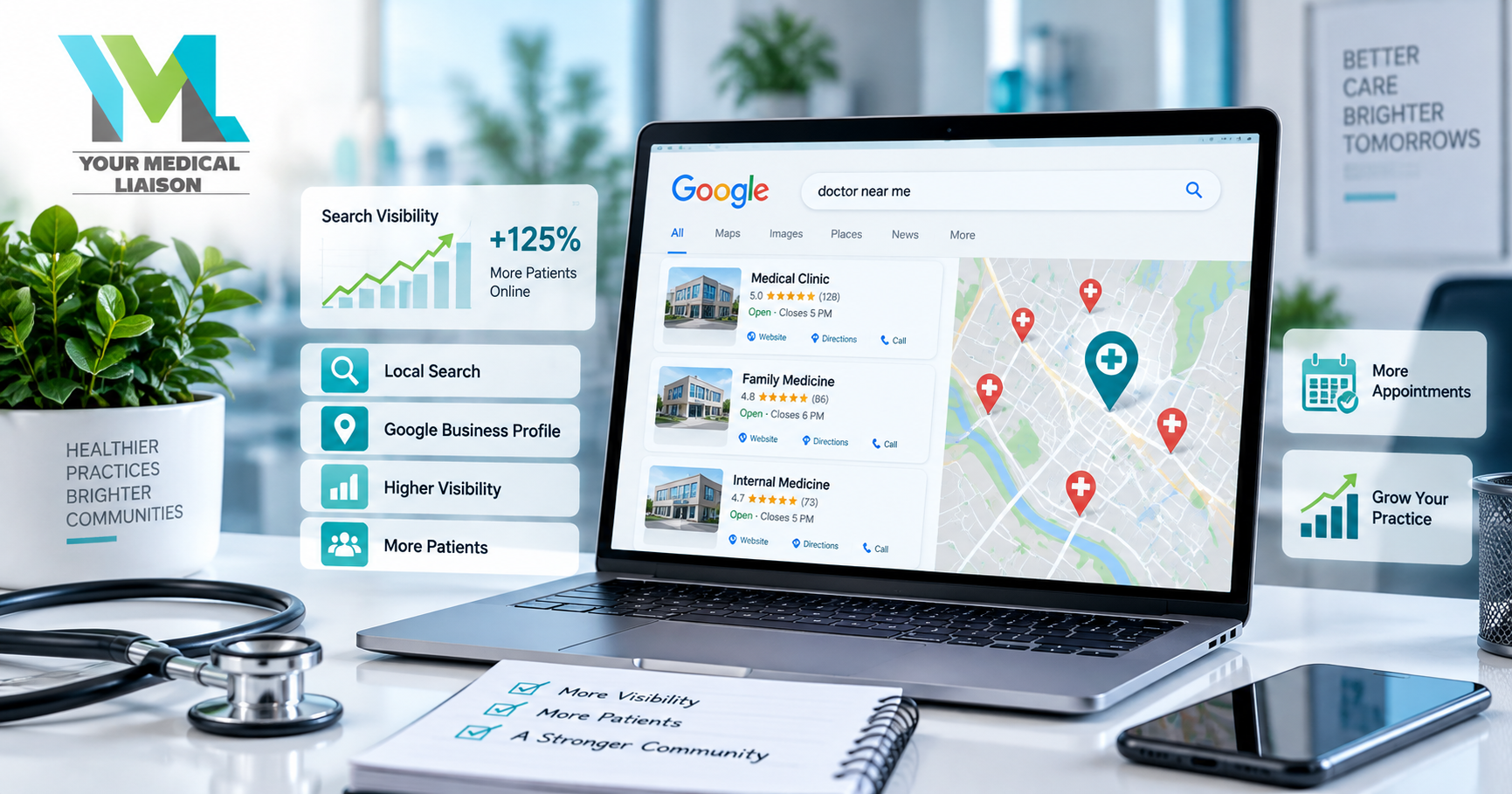
Search has quietly become the modern waiting room. Long before a patient calls to book an appointment, they’re typing “specialty near me” into Google or asking an AI assistant to compare providers nearby. A Rater8 patient survey found that 55% of patients start their search this way, and that they trust Google’s AI Overviews more than any other part of the results page.[1] For medical practices, this shift means online visibility now shapes whether patients ever get the chance to experience your care. If a clinic doesn’t appear in local search results, Google Maps, or AI-generated summaries, it risks losing patients who never even knew it existed. This is where local SEO steps in, helping practices connect with the patients already searching for them.
This blog breaks down what local medical practice search engine optimization for doctors actually means, how it directly improves a practice’s online visibility, the proven strategies that drive results, and what it takes to stay ready for AI-powered search.
Local SEO Visibility SnapshotMedical practices now compete for patients through Google Business Profile completeness, review quality and recency, accurate and consistent business information, structured data, and AI Overview readiness. Google names relevance, distance, and prominence as its local ranking factors. Service pages built for patient decisions, healthcare-specific directory listings, privacy-conscious review processes, and E-E-A-T-backed content compound over time, positioning practices to capture nearby, high-intent searches across both traditional and AI-generated results. |
What Is Local SEO for Doctors
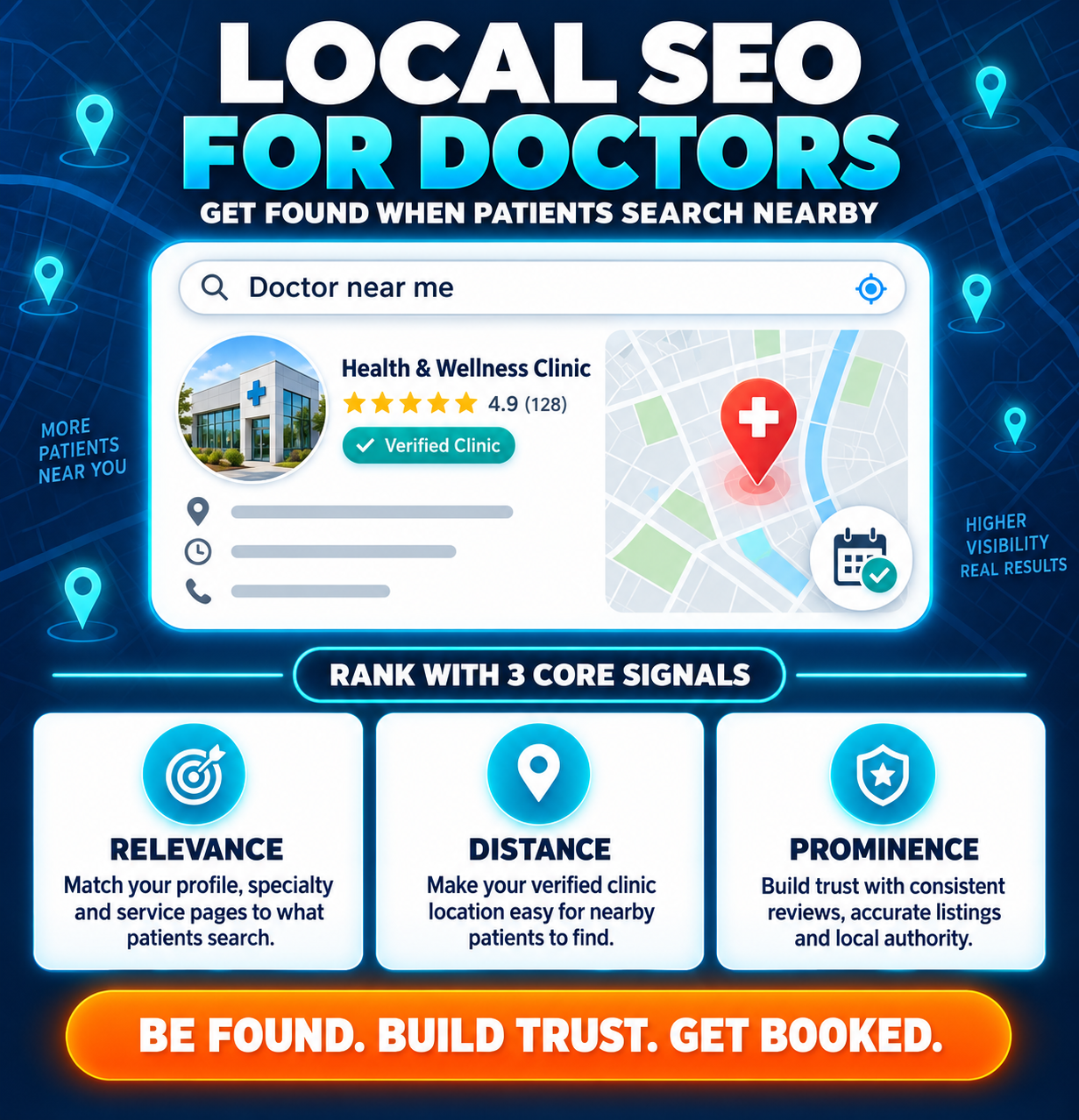
Local medical practice search engine optimization for doctors is the practice of optimizing a medical practice’s online presence so it appears prominently when nearby patients search for care, whether through “urgent care near me” or “pediatrician in Nevada”. It centers on three ranking pillars: relevance, proximity, and prominence, achieved through an optimized Google Business Profile, consistent NAP details, location-specific service pages, and genuine patient reviews. Unlike general SEO, which targets broad or national queries, local SEO for medical practices focuses squarely on geographic intent, which matters most for functional and integrative medicine MD/DOs whose patients research their options carefully before booking.
See how Your Medical Liaison’s tailored programs can grow your patient volume through SEO, reviews, and AI search readiness.
How Medical Practice SEO Boosts Online Visibility
It secures top placement in Google’s Map Pack
Whitespark’s annual survey of local SEO experts estimates that Google Business Profile signals account for roughly 32% of local pack ranking weight in 2026. This industry estimate by a third party is quite useful. [2] For medical practices, a fully optimized profile is one of the highest-leverage free assets a clinic controls. Completing every field, from hours to attributes, helps Google understand the practice and match it to relevant searches.
It strengthens the pillars Google actually measures
Google’s local algorithm names three official ranking factors: relevance, distance, and prominence. Since practices can’t move their physical address, medical SEO marketing work concentrates on the two controllable levers: relevance (matching search intent through categories and services) and prominence (authority built through reviews and citations). This targeted focus is why SEO consistently outperforms scattergun marketing for visibility gains.
It multiplies visibility through review velocity
For healthcare and dental practices specifically, reviews account for the majority of ranking weight, higher than almost any other industry category studied. For example, a practice with a fresh 4.6 rating can now outrank a competitor with a stale 4.9. This shift rewards practices that treat reviews as an ongoing local SEO for doctors activity rather than a one-time collection effort, directly compounding visibility over time.
It prevents exclusion from AI-generated local answers
Google AI Overviews now appear in most of the local searches. The strongest predictor of AI Overview inclusion is Google Business Profile completeness combined with quality reviews and a significant response rate, meaning practices neglecting either input effectively disappear from this fast-growing visibility channel entirely.
Proven Local SEO Strategies for Medical Practices
Build service pages structured for patient decision-making, not keyword stuffing
Layer service content in order of priority: dedicated pages for every treatment, individual physician bio pages with credentials and board certifications, and high-value procedure landing pages before investing heavily in blog content. Each service page should cover what the treatment involves in plain language, who’s a good candidate, recovery timelines, and cost or insurance information, and provider qualifications. Make each page comprehensive enough to answer what patients need to decide. This structure answers what patients actually evaluate before booking.
Get listed on healthcare-specific directories, not just general ones
Beyond a standard Google Business Profile, practices need presence on medical-specific platforms and licensing-body directories, with every field completed: accepted insurances, “accepting new patients” status, and a professional photo. Each additional consistent citation strengthens the prominence signal Google uses to judge legitimacy, and healthcare-specific directories carry more topical relevance than generic business listings, making them disproportionately valuable for medical practice search engine optimization specifically.
Enforce exact NAP consistency across every single listing
Use the same practice name, address, and phone number on your website, Google Business Profile, and key directories. Small formatting differences such as “St.” and “Street” are not the concern. Wrong, outdated, or conflicting details are. Audit every citation to ensure name, address, and phone number match character-for-character, since NAP consistency remains one of the three factors experts consistently rank among the most important for local healthcare visibility.
Run HIPAA-compliant review generation as an ongoing system
Never confirm that someone is a patient or discuss their care in a public reply. If review requests involve protected health information, use vendors and secure channels appropriate to your privacy obligations. Obtain proper written authorization before publishing testimonials or any identifiable patient details. HHS has taken HIPAA enforcement action over a practice’s public response to an online review, so treat every reply with care. [3] Consult your compliance advisor to set up a process that fits your practice.
Implement LocalBusiness and MedicalClinic schema markup site-wide
Structured data helps search engines understand your practice’s type, location, and hours. It can make pages eligible for certain search features, but it does not guarantee any specific display. Google also limits review markup that a business publishes about itself, so don’t expect star ratings from on-site reviews. [4] At minimum, mark up your homepage and key location pages so the markup accurately matches what visitors see.
Create location-specific content with embedded local context
For multi-location practices, build a dedicated page per location with an embedded Google Map, driving directions, parking information, and city or neighborhood names naturally worked into titles and headers. This geographic signal reinforces relevance for “near me” searches and gives Google clearer entity data to match against a searcher’s actual location, directly supporting local pack placement.
Layer E-E-A-T signals through named authorship and clinical review
Attribute every clinical post to a qualified professional with photo, credentials, and a linked profile page, and route content through a genuine medical review process before publishing. Cite authoritative external sources like PubMed or national clinical guidelines, and use internal linking so service pages connect to condition guides, which connect back to physician bios, compounding topical authority across the entire site.
Conclusion
Local SEO for medical practices now decides which practices patients discover, from Google Business Profile signals to AI Overview readiness. Practices treating these strategies as ongoing, not one-time, will keep pace with search shaped increasingly by AI. Since implementation takes sustained effort, Your Medical Liaison offers customized SEO, GBP management, and reputation strategies built for physicians since 2012. For functional and integrative medicine MD/DOs, that means comprehensive marketing oversight with measurable ROI, less workload, and more time to buy back for patients and personal well-being.
Ready to turn these strategies into a real growth plan for your practice? Talk to a healthcare marketing specialist who understands medical SEO.
Common Questions About Medical Practice SEO
Can a new practice with no online history rank locally?
Yes. A new practice needs time for Google to crawl and index its site, and to build local authority, reviews, and citations. Timelines vary, so focus on a complete Google Business Profile, accurate listings, and steady review growth.
Do multiple locations need separate SEO strategies?
Yes, each location needs its own Google Business Profile, dedicated location page, and localized citations, since Google ranks each address as a distinct local entity.
Can duplicate Google Business Profile listings hurt a practice’s ranking?
Yes, duplicate listings split review counts and confuse Google’s relevance signals, so merging duplicates is a standard early step in any local SEO cleanup.
What keywords should a medical practice target for local SEO?
Effective keywords combine specialty, location modifier, and intent, such as “pediatric dermatologist near downtown”. Prioritize patient relevance, local intent, service fit and realistic demand.
How do patients typically phrase voice searches for healthcare?
Most voice queries are local and symptom-focused, like “clinic near me that accepts my insurance” or “dermatologist open on Saturday,” rather than typed keyword phrases.
Sources:
[1] Rater8. “2026 Patient Choice Report: How AI, Online Reviews, and Rising Standards Have Redrawn the Path to Care
[2] Healthcare Growth Strategies. “Whitespark’s 2026 Local Search Ranking Factors: What Actually Moves Rankings.”
[3] 2 HHS. “HIPAA enforcement example involving online reviews (Manasa Health Center).”
[4] Google Search Central. “Local business structured data
