
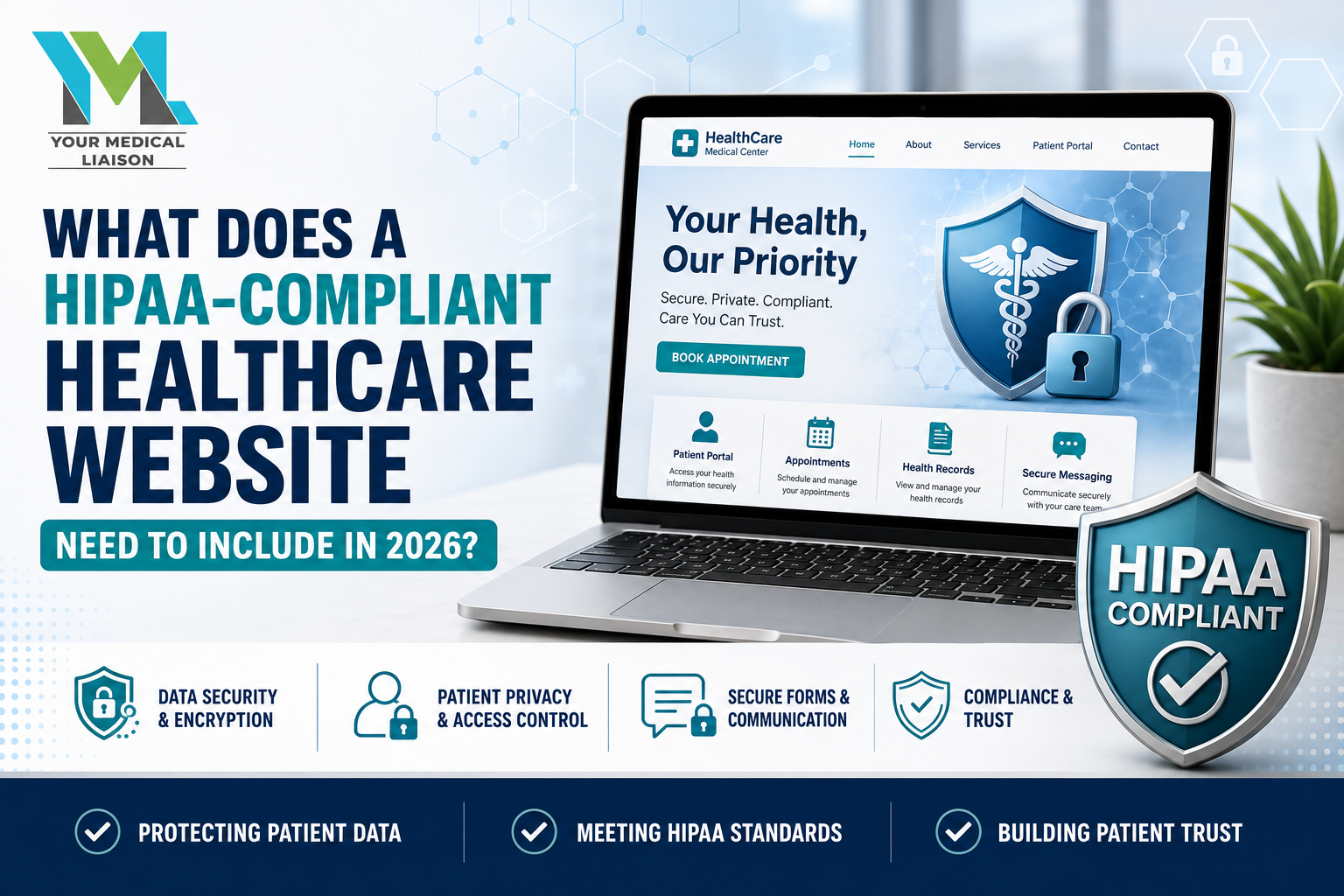
A healthcare website is often the first place patients go to book appointments, share personal details, or learn about medical services. But with sensitive health information being exchanged online, security and privacy cannot be treated as optional. In 2026, a HIPAA-compliant healthcare website needs to be designed with patient protection and regulatory requirements in mind. This involves securing data transmission, providing proper access controls, giving patients reliable communication systems, and carefully handling third-party tools.
For healthcare providers, developers, and administrators, this means understanding requirements to reduce security risks and create a safer online experience. To help in this endeavor, this guide explains the essential elements a HIPAA-compliant healthcare website should include and the best practices, along with medical website design services to consider when building or updating one.
HIPAA Compliance Overview in 2026A HIPAA-compliant healthcare website in 2026 requires more than written policies. It demands secure encryption, protected patient portals, HIPAA-compliant forms, role-based access controls, audit logging, and careful third-party vendor management. Transparent privacy policies, continuous security monitoring, accessibility, and disaster recovery further strengthen compliance while safeguarding Protected Health Information (PHI). Together, these measures reduce cybersecurity risks, meet evolving regulatory expectations, and foster patient trust through secure, reliable, and privacy-focused digital healthcare experiences. |
Why HIPAA Compliance Matters for Healthcare Websites in 2026
A Written Policy is No Longer Enough for the Office for Civil Rights
Having a written HIPAA policy is no longer enough. Regulators now check if practices are actually followed. Since 2024, HHS’s Risk Analysis Initiative [1] has settled several cases involving practices that had outdated or missing risk assessments, even if they had a policy in place on paper.
Analytics and Pixel Trackers Can Trigger HIPAA Violations
Tools like Meta Pixel and Google Analytics are common, but they quietly send visitor data to outside companies. If that data ties a patient’s IP address to their health information, it’s a HIPAA violation [2], whether the practice meant for it to happen or not. And since companies like Meta and Google won’t sign the data protection agreements HIPAA requires, there’s no easy fix.
Patients Are Holding Providers Accountable for Data Protection
Patients care about how their health information is handled, which hasn’t changed. Federal data [3] shows most patients trust that their medical records are safe from unauthorized access, but that confidence drops when it comes to sharing information electronically between providers. In other words, trust isn’t a given. It’s earned through how consistently an organization protects patient data, and that includes its website.
Need a HIPAA-compliant website built for your healthcare practice? Let’s create something secure, patient-friendly, and built to perform!
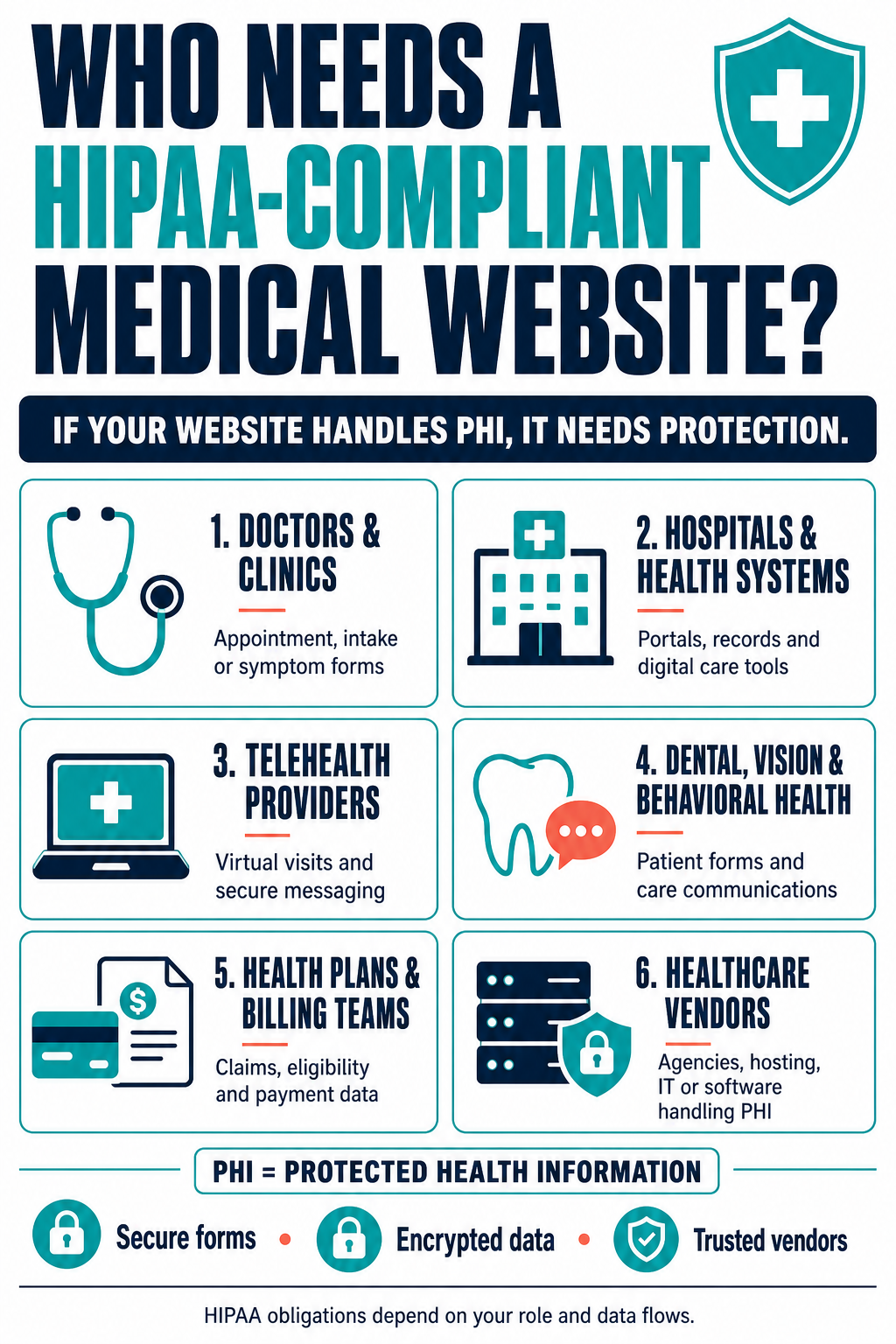
Who Needs a HIPAA-Compliant Medical Website?
Not every health-related website has to follow HIPAA rules. That’s exactly why more practices are turning to medical website design services to get this right from the start. Here’s who actually needs a HIPAA-compliant website, and why assuming you don’t is risky.
Essential Features Every HIPAA-Compliant Healthcare Website Should Include
Advanced Data Encryption and Secure Hosting
A HIPAA-compliant healthcare website must protect all patient information through robust encryption and secure hosting infrastructure.
- Every page should use HTTPS with modern TLS encryption (preferably TLS 1.3) to safeguard data transmitted between users and the website, while sensitive information stored on servers should also be encrypted to prevent unauthorized access.
- Secure hosting environments with firewalls, intrusion detection systems, regular security patches, and encrypted backups further strengthen protection against cyberattacks.
Since healthcare organizations remain one of the primary targets for ransomware and data breaches, implementing strong encryption and secure hosting is the first line of defense for protecting Protected Health Information (PHI) and maintaining patient trust.
Secure Patient Portals with Multi-Factor Authentication
Modern healthcare websites should provide patients with secure portals where they can access medical records, laboratory results, prescriptions, appointment history, billing information, and communicate with providers. Because these portals contain highly sensitive health data, relying solely on passwords is no longer sufficient. Multi-Factor Authentication (MFA), combined with automatic session timeouts and secure login monitoring, significantly reduces the risk of unauthorized access caused by stolen credentials or phishing attacks. This not only supports HIPAA compliance but also improves patient engagement by providing convenient and protected access to healthcare services.
HIPAA-Compliant Forms and Secure Communication Channels
Healthcare websites frequently collect patient information through appointment requests, contact forms, telehealth registrations, prescription refill requests, and online consultations. Every data collection point must be encrypted and securely stored to prevent accidental exposure of PHI. Additionally, patient communication should occur through encrypted messaging systems rather than standard email or unsecured chat platforms. Using HIPAA-compliant forms and secure messaging ensures confidential communication between patients and providers while reducing compliance risks and strengthening patient confidence in the organization’s digital services.
Role-Based Access Control and Continuous Audit Logging
Not every employee within a healthcare organization requires access to every patient’s medical information. HIPAA follows the principle of minimum necessary access, making Role-Based Access Control (RBAC) essential for limiting information based on an employee’s responsibilities. [4] Alongside access controls, websites should maintain comprehensive audit logs that record login attempts, file access, data modifications, downloads, and administrative actions. These logs help organizations detect suspicious activity, investigate potential security incidents, demonstrate regulatory compliance, and maintain accountability across the entire healthcare system.
Privacy-First Third-Party Integrations and Vendor Compliance
Healthcare websites often depend on third-party services for appointment scheduling, cloud hosting, payment processing, analytics, telehealth, customer support, and email communications. However, every external vendor that handles Protected Health Information must comply with HIPAA requirements and, where applicable, sign a Business Associate Agreement (BAA). Organizations should carefully evaluate vendors for their security practices, limit unnecessary data sharing, and ensure third-party tools do not expose patient information. Proper vendor management significantly reduces supply chain security risks while supporting long-term regulatory compliance.
Transparent Privacy Policies and Regulatory Compliance
Patients increasingly expect transparency regarding how their personal and medical information is collected, used, stored, and shared. A HIPAA-compliant website design for a medical practice should prominently display an up-to-date Privacy Policy, Notice of Privacy Practices (where applicable), Terms of Use, and Cookie Policy that clearly explain data handling practices and patient rights. Providing transparent privacy information helps patients make informed decisions, builds organizational credibility, and demonstrates a commitment to regulatory compliance and ethical data management in an increasingly privacy-conscious digital environment.
Continuous Security Monitoring, Accessibility, and Disaster Recovery
HIPAA compliance is an ongoing process rather than a one-time implementation. Healthcare websites should undergo continuous vulnerability assessments, penetration testing, software updates, malware monitoring, and security audits to identify and address emerging threats before they lead to data breaches. At the same time, websites should be mobile-responsive and accessible according to WCAG guidelines so all patients, including individuals with disabilities, can access healthcare services without barriers. [5] Regular encrypted backups and a well-defined disaster recovery plan ensure that patient information remains available even during cyberattacks, system failures, or natural disasters, allowing healthcare organizations to maintain business continuity while protecting sensitive medical data.
Conclusion
A pretty website isn’t enough anymore; it needs to keep your patients’ information safe. That’s where we come in as a medical website design company. At Your Medical Liaison, we build secure, HIPAA-compliant websites made specifically for physicians and functional and integrative providers. We sweat the details, from secure forms to vendor agreements, so you don’t have to. You focus on your patients. We’ll handle the rest.
Ready to build or redesign your healthcare website? Let’s create something secure, compliant, and built to perform!
FAQ’s About HIPAA-Compliant Healthcare Websites
Does a small private practice need a HIPAA-compliant website, or is this only for hospitals?
Yes, size doesn’t matter. If your website collects or handles any patient health information, HIPAA rules apply to you, too. Even small clinics have been fined for the same mistakes big hospitals make.
What happens if a patient accidentally submits sensitive health information through a non-compliant contact form?
Even if it’s an accident, it still counts as sharing patient information under HIPAA. Depending on how the data was stored, this might require notifying patients, so even simple contact forms carry risk.
Do telehealth or video consultation links on my website need to be HIPAA-compliant, too?
Yes. Any video tool on your website must have a signed data protection agreement with its provider and use a secure, encrypted connection, and the same rule applies to forms and hosting.
Can I use WordPress for a HIPAA-compliant healthcare website?
Yes, but it needs extra work. WordPress alone isn’t HIPAA-compliant; it needs secure hosting, encrypted forms, and signed agreements with every plugin or tool that touches patient information.
Is a Notice of Privacy Practices required on a healthcare website?
Yes, if HIPAA rules apply to your practice. Most healthcare organizations post their Notice of Privacy Practices on their website so patients can easily find it, in addition to giving it in person.
Sources:
[1] U.S. Department of Health and Human Services, Office for Civil Rights. (2025). Guidance on risk analysis. https://www.hhs.gov/hipaa/for-professionals/security/guidance/guidance-risk-analysis/index.html
[2] U.S. Department of Health and Human Services, Office for Civil Rights. (2022). Use of online tracking technologies by HIPAA covered entities and business associates. https://www.hhs.gov/hipaa/for-professionals/privacy/guidance/hipaa-online-tracking/index.html
[3] Office of the National Coordinator for Health Information Technology. (2019, June). Individuals’ perceptions of the privacy and security of medical records and health information exchange. HealthIT.gov. https://www.healthit.gov/data/quickstats/individuals-perceptions-privacy-and-security-medical-records-and-health-information
[4] U.S. Department of Health and Human Services. (n.d.). Summary of the HIPAA Security Rule. Retrieved August 3, 2026, from https://www.hhs.gov/hipaa/for-professionals/security/laws-regulations/index.html
[5] World Wide Web Consortium. (n.d.). Web Content Accessibility Guidelines (WCAG) overview. Retrieved August 3, 2026, from https://www.w3.org/WAI/standards-guidelines/wcag/
