

A medical website should help patients understand a practice, find relevant services, and take the next step with confidence. For functional and integrative medicine MDs and DOs, the site may also need to explain whole-person services and help prospective patients decide whether the practice fits their needs. A specialized healthcare marketing partner can help attract aligned patients and reduce the time physicians spend managing website and marketing tasks. These considerations can also apply to practices in other specialties.
Consider hiring a medical website design company when routine edits cannot resolve barriers to patient access, privacy-sensitive functionality, search visibility, accessibility, or planned growth. The seven signs below can help you decide whether your site needs professional support.
Medical Website Design: Key Insights and Timing
A professional medical website builds patient trust through clear service information, accessible navigation, mobile responsiveness, and search visibility. Hiring a specialist becomes valuable when practices expand services, add providers, struggle with online discovery, or make essential information difficult to find. Effective website design for medical practice supports secure, patient-focused digital experiences, scalable growth, and smoother appointment journeys through tailored medical website design services and healthcare-specific expertise.
When Should You Hire a Medical Website Design Company?
Your Practice Has Introduced New Medical Services
When a practice adds treatments, diagnostic procedures, or specialties, the current website may not explain what is offered, who provides each service, or how patients can ask about it. For example, a functional or integrative practice adding nutrition counseling or lifestyle-focused services may need dedicated pages that describe those offerings clearly and help prospective patients understand whether they are relevant to them.
Your Website Is Difficult to Use on Mobile Devices
If patients have trouble reading content, navigating menus, completing forms, or finding appointment options on a phone, the site may need professional attention. Review key pages and tasks on several screen sizes. If the problems affect much of the site, a specialist can assess whether targeted fixes or a broader redesign is appropriate.
Patients Struggle to Find Essential Practice Information
Repeated questions about insurance, locations, office hours, provider availability, or appointment preparation may signal that important details are hard to find. Clear navigation and well-organized pages can make this information easier to locate and reduce avoidable friction for patients and staff.
Your Practice Has Expanded to Multiple Providers or Locations
Adding clinicians or locations can make provider qualifications, specialties, services, and appointment details harder to organize. A site built for one practitioner may need a new structure, individual provider profiles, or location-specific information as the practice grows.
Your Medical Practice Is Difficult to Find in Search Results
If prospective patients have difficulty finding the practice for relevant specialty, service, or local searches, the site may have content or technical limitations. Examples include missing service pages, unclear headings, duplicate information, or important pages that search engines cannot access. A website professional can assess whether the issue requires changes to site structure, content, or its underlying platform.
Your Website Needs Privacy-Sensitive Patient-Facing Features
Appointment requests, intake forms, telehealth links, and patient portal connections can involve personal or health information. A design project does not by itself make a website HIPAA-compliant. Before launch, ask qualified privacy and security advisers to review data flows, forms, analytics and tracking pixels, scheduling tools, portal integrations, vendor agreements where applicable, and how protected health information is handled.
Your Website Does Not Meet Patients’ Accessibility Needs
If people using screen readers, keyboard navigation, or other assistive technology encounter barriers, the site may need an accessibility review. Issues can include low color contrast, unlabeled form fields, inaccessible menus, or appointment steps that require a mouse. WCAG provides testable guidance for digital accessibility, but a design update alone does not establish conformance; evaluate the site and its essential workflows against the applicable requirements.
Why Is Professional Medical Website Design Important for a Practice?
A website is one place patients can review practice information as they compare health resources. Pew Research Center reported that 85% of U.S. adults get health information from health care providers at least sometimes, while 60% do so from major health websites. The figures describe information sources; they do not predict results for an individual practice.
Establishing Patient Trust and Medical Credibility
Clear, current provider profiles, service descriptions, credentials, and practice details help visitors understand who provides care and what the practice offers. Functional and integrative practices can use this space to explain their approach in accurate, understandable language without overstating outcomes.
Makes Healthcare Information Easier to Understand
Plain language, descriptive headings, readable text, and logical page structure help patients find and understand the information they need. Keep treatment descriptions accurate and distinguish general education from individualized medical advice. The U.S. Department of Health and Human Services emphasizes user-centered design and plain language as essential elements of accessible digital health information.[2]
Supports Patient Privacy and Data Security
Privacy obligations depend on the practice, the information collected, the tools and vendors involved, and how data moves through the site. HHS guidance discusses how tracking technologies may involve protected health information in some circumstances. For HIPAA-regulated organizations, website technologies that collect or disclose protected health information must meet applicable privacy and security requirements.[3]
Improves Accessibility for Patients With Different Needs
Readable text, visible focus states, keyboard-accessible navigation, descriptive form labels, and sufficient contrast can make common website tasks easier for more visitors. The Web Content Accessibility Guidelines (WCAG) provide internationally recognized recommendations for improving digital accessibility, helping practices make online healthcare information and services usable by more patients.[4]
Simplifies Appointment Scheduling and Patient Access
Clear contact details, service information, and well-placed appointment pathways can help visitors understand how to contact the practice. Any form, scheduling tool, or portal integration should be assessed for usability, privacy, security, and the practice’s operational needs before it is introduced.
Ready to increase your medical presence digitally? Your Medical Liaison provides healthcare-focused website strategy, optimization, SEO, AEO, and digital marketing support tailored to providers.
What Should You Prepare Before Hiring a Medical Website Design Company?
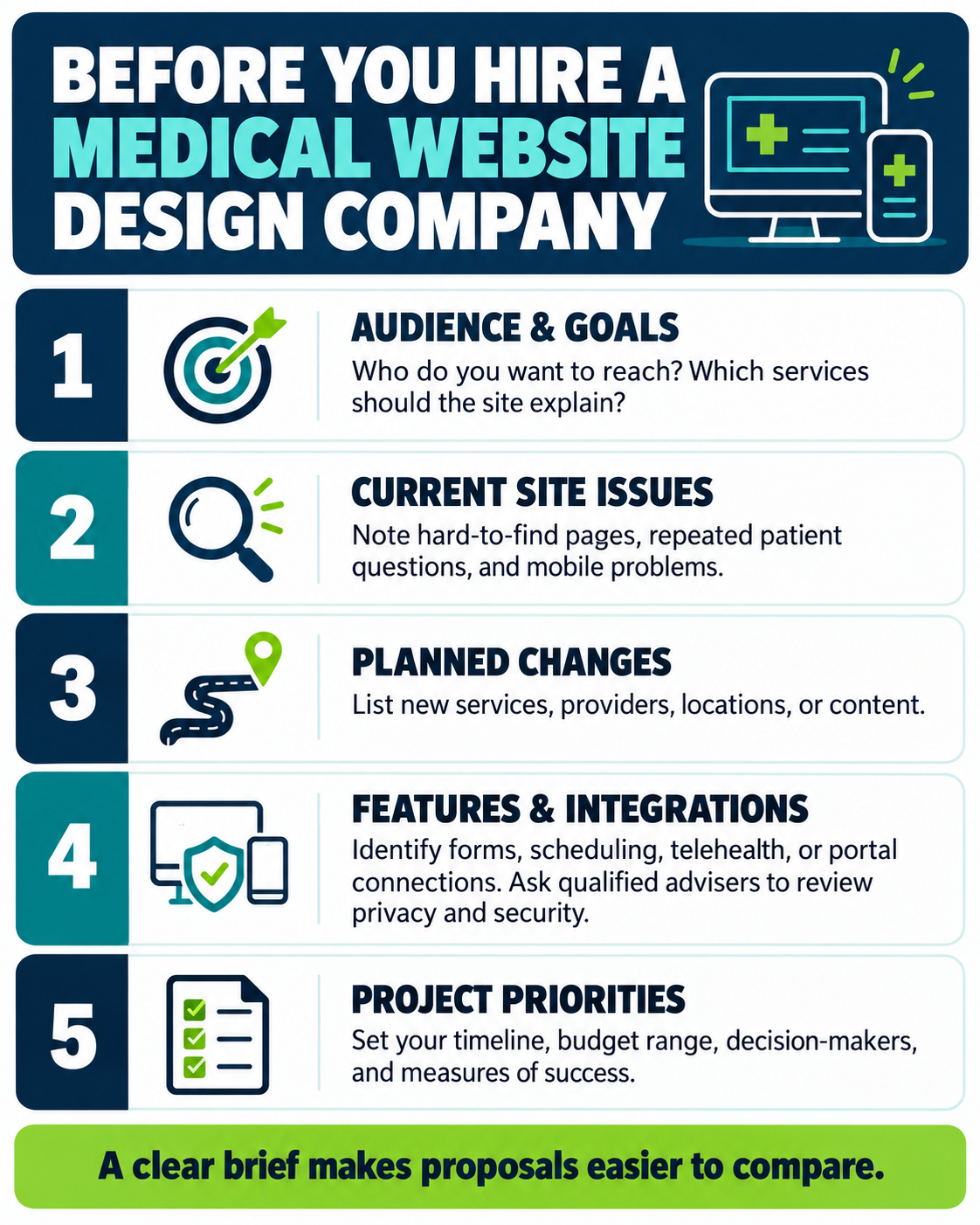
Once you’ve identified a need for professional website support, a little preparation can make the first conversation more productive. Gather your practice goals, the website problems patients and staff encounter, planned changes, and any tools that handle patient information. For functional and integrative practices, include the services you want to explain and the patients you hope to reach. This gives a potential design partner a clearer picture of the project and helps you compare proposals.
Conclusion
A medical website should make practice information easier to find, understand, and use. Your Medical Liaison coordinates healthcare website strategy, design, SEO, and the integrations a practice needs, with attention to patient experience, privacy, and accessibility. For functional and integrative medicine physicians and other providers, a well-planned digital presence can support clearer communication with prospective patients and leave physicians with more time for care. Specific privacy, security, and accessibility requirements should be reviewed for each practice and implementation.
Look past your website with a tailored marketing approach. Explore our medical marketing programs designed to strengthen patient engagement, nurture opportunities, and support sustainable practice growth.
Frequently Asked Questions About Hiring a Medical Website Design Company
How Long Does It Take to Build a Medical Website?
A medical website typically takes several weeks to complete, depending on page count, functionality, content preparation, revisions, integrations, and approvals.
Could an increasing number of website visitors signal the need for professional help?
Yes. Rising traffic with limited engagement may indicate that your website needs stronger user experience, content alignment, technical performance, or conversion strategy.
Would merging two medical practices require professional website planning?
Often. A merger may require coordinated changes to branding, provider information, practice details, content, and website structure to create one consistent presence.
Might a change in ownership require a professionally updated medical website?
As ownership changes can affect branding, leadership information, messaging, legal details, and other website elements, it requires coordinated updates and professional implementation.
Could joining a healthcare network create a need for website assistance?
Potentially. Network affiliations can introduce new branding, provider, organizational, and communication requirements that may need coordinated website implementation.
Does hiring a website design company make a website HIPAA compliant?
No. Design alone cannot establish HIPAA compliance. The practice should have qualified privacy and security advisers review applicable data flows, tools, vendors, agreements, and safeguards for its specific setup before launch.
Sources:
[1] Pew Research Center: Where Do Americans Get Health
[2] US DEPARTMENT OF HEALTH AND HUMAN SERVICES: Digital at HHS
[3] US DEPARTMENT OF HEALTH AND HUMAN SERVICES: Use of Online Tracking Technologies by HIPAA Covered Entities and Business Associates
[4] The Web Content Accessibility Guidelines (WCAG): Web Content Accessibility Guidelines (WCAG) 2.2
