

For functional and integrative medicine MDs and DOs, physician liaison campaigns can help referring offices understand which patients are a good fit for the practice. A partner that manages outreach from planning through reporting can support practice growth without asking physicians to run the campaign themselves. The same hiring questions apply to other specialists evaluating field outreach.
An agency proposal can look convincing before it explains who will represent your practice, what they will say, or how their work will be evaluated. Avoiding medical field marketing mistakes starts with asking those questions before signing, not after the first reporting cycle. You are selecting people who may become a referring office’s introduction to your organization, so their judgment matters alongside their presentation skills. A useful hiring process examines the team, the operating plan, the safeguards, and the evidence behind promised results. It also establishes what your own staff must contribute. When those expectations are clear, you can compare agencies on their ability to do the work rather than on an impressive pitch or an ambitious list of contacts.
Medical Field Marketing Agency Selection Overview
For functional and integrative medicine physicians and other specialists, look for a partner that can manage physician outreach from planning through reporting. Ask who will represent your practice, how offices are selected, what your staff must handle, and how results will be measured. Confirm safeguards, approval responsibilities, costs, and handover terms before signing.
Key Hiring Mistakes Healthcare Practices Should Avoid
1. Buying a Contact List Instead of a Campaign Plan
A large directory is not an explanation of whom an agency should approach or why. Before agreeing to outreach, ask how the proposed offices match your clinical services, locations, access arrangements, and available capacity.
An agency should be able to explain its selection criteria without claiming every nearby physician is a good prospect. It should also distinguish existing relationships from unfamiliar offices and describe how it will verify contact information.
Ask for a sample account plan using fictional information. Look for a clear reason to approach each office, an appropriate contact, and a useful purpose for the conversation. The exercise tests strategic thinking without requesting another client’s confidential records.
2. Assessing the Salesperson but Not the Field Team
The person who wins your account may not be the person visiting referring offices. Make the delivery team part of the evaluation before you commit.
Ask who will represent you, how many accounts they cover, what supervision they receive, and what happens if they leave. Relevant experience should include explaining clinical services accurately and knowing when to defer a question, not simply being comfortable making introductions.
A short role-play can reveal more than a polished biography. For example, ask how a representative would respond when an office requests a service your practice does not provide. Look for an honest clarification and an appropriate escalation, not an attempt to preserve interest through an unsupported promise.
Strong referral networks start with the right conversations. Your Medical Liaison helps healthcare practices connect with relevant physicians through targeted, relationship-driven field marketing.
3. Confusing Frequent Visits With Useful Access
One of the physician outreach mistakes worth screening for is a visit schedule built around the agency’s quota rather than the receiving office’s preferences.
Ask how representatives arrange introductions, respond to requests for less frequent contact, and communicate with referral coordinators or office managers. Repeated uninvited visits should not be the default answer to limited access.
The plan should also explain what makes a return visit useful. A verified service update, an answer to an earlier question, or clarification of referral requirements provides a reason to reconnect. Repeating the same presentation does not.
Before approving a proposal, compare the promised frequency with the team’s stated purpose for each contact. If the agency cannot explain the purpose, ask it to revise the plan rather than merely increase the activity target.
4. Accepting Results Without Definitions or Context
A case study stating that referrals increased is incomplete without a baseline, a reporting period, and an explanation of what was counted. Ask whether the result represents referral orders, scheduled appointments, completed visits, or something else.
Those measures are not interchangeable. A referral may not progress to an appointment because of patient preference, coverage, capacity, or other circumstances. Similarly, changes in staffing or available services can influence results during a campaign.
Request an anonymized sample report and ask the agency to distinguish directly documented work from estimated impact. It should be comfortable explaining what its data cannot establish.
A useful healthcare field marketing strategy sets measurable commitments around work the agency can control, while treating referral outcomes as influenced by several teams and external factors.
| Proposal claim | Question to ask before hiring |
| “We have extensive physician relationships.” | Which relationships are relevant to our services, and how will continuity be managed? |
| “We will increase referrals.” | What exactly will you measure, against which baseline, and with what attribution limits? |
| “Your campaign includes regular visits.” | What makes each visit useful, and how will office preferences shape the schedule? |
| “Our reporting is comprehensive.” | Can we see a fictional or properly anonymized example and the definitions behind it? |
5. Leaving Practice Readiness Out of the Scope
Some medical marketing challenges cannot be solved by sending more representatives into the field. If appointment access is limited or referral instructions are outdated, additional outreach may introduce more offices to the same unresolved problem.
Ask whether onboarding includes a review of approved service information, referral routes, contact responsibilities, and the process for raising administrative concerns. Your practice needs an internal owner for questions the agency cannot resolve itself.
The contract should distinguish what the agency will identify from what your team must fix. Representatives can report an unclear intake requirement; they should not independently change clinical criteria or promise scheduling exceptions.
A sensible launch plan allows essential information to be checked before it is distributed. That is preparation, not unnecessary delay.
6. Treating Compliance as a Standard Line in the Proposal
“Healthcare experience” is not a substitute for reviewing how the agency will operate. Discuss representative conduct, proposed gifts or meals, compensation arrangements, and escalation procedures with qualified compliance or legal advisers before launch.
HHS Office of Inspector General guidance warns that benefits offered to influence referrals can create legal problems. The federal Anti-Kickback Statute addresses knowing and willful remuneration intended to induce or reward business involving federally reimbursable services. Its application depends on the facts and applicable protections. [1]
Do not assume that a fixed fee automatically makes an arrangement permissible, or that a performance-based arrangement can be assessed from its label alone. Have the actual terms reviewed.
Screening for referral marketing mistakes should therefore include asking who approves campaign activities and how representatives handle a request they are not authorized to fulfill. This is educational guidance, not legal advice.
7. Giving Broad Data Access Without Establishing a Need
An agency does not automatically need patient records to maintain professional office relationships. Ask what information it wants, why it needs it, where it will be stored, and who can access it.
If the work makes the vendor a HIPAA business associate, the applicable requirements include a business associate agreement and appropriate safeguards. HHS explains that business associate contracts must establish permitted uses and disclosures and other required protections. [2]
A claim of being “HIPAA certified” is not a substitute for those obligations. HHS explicitly states that a business associate cannot replace a required agreement with self-certification or third-party certification. [3]
Agree on approved systems, subcontractor involvement, incident reporting, and data handling at termination. A signed agreement is part of the framework, not blanket permission to use information for any campaign purpose.
8. Signing Without an Exit and Handover Plan
Evaluate the end of the relationship before agreeing to its beginning. Otherwise, your practice may discover that it cannot readily access campaign materials, business contact records, or an understandable history of completed work.
Specify deliverables, review meetings, approval responsibilities, additional expenses, notice periods, and termination terms. Clarify which materials and records your practice will receive, subject to applicable rights and restrictions.
Also ask how open commitments will be handed over. If an office is waiting for an answer when the contract ends, your team should know what was promised and who should follow up.
A scoped pilot may help you assess delivery before a longer engagement. Define its evaluation criteria in advance rather than expecting a short trial to prove lasting changes in referral behavior.
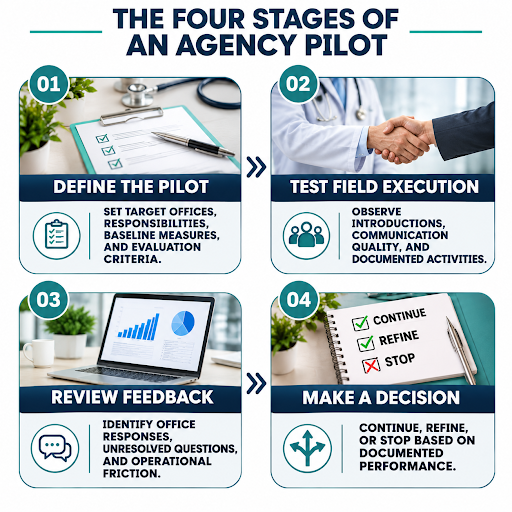
How to Evaluate a Medical Field Marketing Agency During a Pilot
A limited pilot can help healthcare practices observe how an agency performs before expanding its responsibilities. Instead of expecting immediate referral growth, establish checkpoints that reveal whether the proposed outreach strategy works in practice. Start with a clearly defined group of referring offices and an agreed evaluation period. Monitor how representatives manage introductions, document office feedback, respond to questions, and coordinate with your internal team. At the end of the pilot, assess the quality of interactions, completed commitments, operational challenges, and opportunities for improvement. These observations provide a more realistic basis for deciding whether to continue, adjust, or discontinue the partnership.
Hire for Delivery, Not Just Confidence
The right partner should make its approach understandable before asking for your commitment. You should know who will represent the practice, what they are authorized to say, how results will be assessed, and how the relationship can end responsibly. Before choosing an agency, use these questions to review the proposal with your operations and compliance teams. Ask for clarification in writing wherever a promise lacks a defined deliverable. A clear agreement gives both sides a stronger starting point for accountable work.
Your Medical Liaison brings medical marketing experience dating back to 2012. Its physician liaison field marketing service supports functional and integrative medicine MDs and DOs as well as other specialists. The team manages office targeting, in-person outreach, follow-up, and monthly reporting so physicians can spend less time coordinating marketing. Defined goals and reporting help the practice assess where its marketing investment is working and where to adjust.
Planning a physician liaison campaign? Talk with Your Medical Liaison about which referring offices to reach, how outreach would be managed, and what your practice would need before launch.
Frequently Asked Questions
Is the Lowest-Priced Agency Necessarily a Poor Choice?
No. Compare the scope, staffing, travel costs, reporting, and handover provisions behind the price. A smaller, clearly defined service can be more appropriate than a larger package your practice does not need.
Can a General Marketing Agency Handle Field Outreach?
Potentially, but assess the actual delivery team and healthcare-specific processes. A strong digital portfolio does not establish that its representatives can accurately explain clinical services or navigate referral-office conversations.
Should We Ask for Guaranteed Referral Numbers?
Ask for clear deliverables, transparent measurement, and evidence instead. An agency cannot control patient choice, clinical decisions, or every operational factor affecting referrals. Have any performance-linked contract terms reviewed appropriately.
What Should We Request Before Signing?
Request the named delivery team, a proposed account-selection method, a sample report, approval procedures, data-handling details, and a written scope. These provide a practical basis for comparing proposals.
Sources
[1] U.S. Department of Health and Human Services, Office of Inspector General (HHS-OIG). (n.d.). II. Physician Relationships With Fellow Providers: Physicians, Hospitals, Nursing Homes, Etc.
[2] U.S. Department of Health and Human Services (HHS). (2013, January 25). Business Associate Contracts: Sample Business Associate Agreement Provisions.
[3] U.S. Department of Health and Human Services (HHS). Instead of entering into a contract, can business associates self-certify or be certified by a third party as compliant with the HIPAA Privacy Rule?
