

Understanding how this approach works and where it fits within a broader practice marketing strategy starts with looking at the fundamentals of field marketing.
Healthcare Field Marketing: Key Takeaways
Healthcare field marketing helps specialty medical practices strengthen professional relationships, identify relevant referral opportunities, and maintain visibility among healthcare providers. Effective strategies combine targeted provider outreach, meaningful relationship building, professional communication, useful practice materials, and consistent follow-up. A tailored approach considers the practice’s specialty, services, geographic market, patient population, and referral network. Ongoing evaluation and relationship management help practices adapt to changing healthcare needs while supporting sustainable growth.
FIELD MARKETING
In healthcare, personal connections remain important, particularly when practices are building relationships with referring providers and other organizations involved in patient care. Field marketing allows practices to establish these connections, strengthen professional relationships, and gain a deeper understanding of their local healthcare market.
Understand Your Local Healthcare Market: What does the local healthcare landscape look like? Review referral patterns, competing services, provider networks, and community needs to identify relevant opportunities. Understanding these factors helps practices determine which healthcare professionals and organizations are most relevant to their outreach efforts.
Build Strategic Healthcare Partnerships:How can networking support practice growth? Target primary care providers, specialists, and complementary healthcare organizations whose patients may benefit from your services, while keeping outreach professional and compliant with applicable referral regulations. Meaningful partnerships develop through relevant communication and consistent relationship management, which are central to effective physician referral strategies from the American Medical Association.
Create a Consistent Professional Presence: How can practices stay visible among relevant healthcare professionals? Consistent, informative outreach, educational resources, and thoughtful follow-up can help maintain awareness and support stronger referral relationships over time. A coordinated field marketing approach also gives practices opportunities to understand provider needs and adapt their communication accordingly.
How to Build an Effective Healthcare Field Marketing Workflow
A structured workflow helps medical practices turn field marketing from occasional outreach into a consistent, measurable process. Each stage builds on the previous one, beginning with clear practice goals and an understanding of the referral ecosystem. Prioritizing relevant providers, preparing accurate information, documenting interactions, and reviewing results creates a practical cycle for improving outreach. Following this sequence can help practices stay organized, use resources efficiently, and adapt their efforts as their markets change.
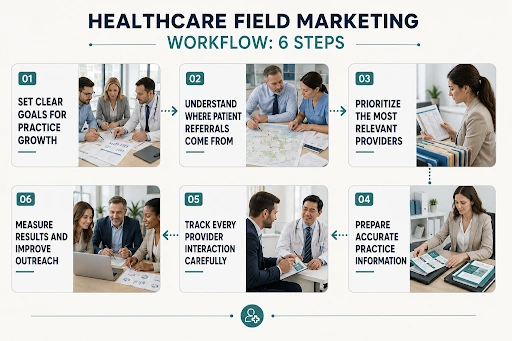
How Healthcare Field Marketing Supports Medical Practice Growth
Effective field marketing is more than visiting medical offices and leaving promotional materials behind. A well-planned approach focuses on identifying relevant referral sources, communicating useful information, building professional relationships, and maintaining those connections consistently.
Targeted Provider Outreach: Successful outreach begins with identifying the healthcare professionals most relevant to a practice’s specialty and patient population. This may include primary care providers, specialists, hospitals, and other organizations involved in coordinating patient care. Prioritizing relevant referral sources allows practices to use their time and resources more strategically.
Relationship Building: Strong professional relationships develop through consistent, meaningful interactions rather than one-time visits. Field marketing representatives can learn about providers’ needs, share relevant practice information, and maintain communication over time. The goal is to establish professional credibility and create useful connections, not simply request referrals.
Representing the Practice Professionally: Field representatives often serve as a direct point of contact between a medical practice and the healthcare professionals it wants to reach. They should understand the practice’s services, areas of expertise, patient experience, and referral processes well enough to communicate accurate information clearly and professionally.
Providing Useful Practice Information: Printed materials, educational resources, service information, and other relevant materials can support conversations with referral sources. Materials should be accurate, current, easy to understand, and appropriate for professional healthcare settings while meeting healthcare marketing and privacy requirements outlined by the U.S. Department of Health & Human Services (HHS).
Consistent Follow-Up: Field marketing works best as an ongoing process. Following up after an initial conversation gives practices an opportunity to answer questions, provide additional information, and maintain professional relationships. Tracking outreach and follow-up activities can also help practices understand which relationships and strategies are generating meaningful engagement over time.
Referral relationships don’t build themselves let’s put a dedicated field marketing plan behind your practice’s growth.
Crafting a Unique Marketing Strategy for Specialty Medical Practices with Your Medical Liaison
In the vast world of medical marketing, it’s easy for specialty practices to get lost in generic, one-size-fits-all strategies. A more effective approach starts with understanding each practice’s specialty, patient population, referral network, and local market. We understand that every specialty medical practice has a unique story and needs a tailored approach. We don’t believe in the cookie-cutter mindset.
At YML, we dive deep. Before strategizing on our end, we initiate the process by listening to YOUR story. We want to know:
- WHO you are: The expertise and passion behind your team.
- WHAT your practice offers: Your specialized treatments, methodologies, and technologies.
- WHERE you operate: Your community, geographic service area, and opportunities for growth.
- WHY you ventured into your specialty: The driving vision, the mission that fuels your every day.
- HOW your practice was established and how patients typically access your services.
This dialogue helps us craft a multidimensional understanding of your practice. From there, it’s like pairing in the world of professional relationships. Using the information, we identify your ideal patient profile. We also consider which providers are most likely to encounter those patients and could benefit from knowing more about your services.
– Who currently trusts and relies on your services?
– Which patient categories do they fall under?
– What frequency and nature of treatments do they require?
– Which referring providers or healthcare organizations are connected to these patient needs?
That’s your “ideal patient” and referral profile.
However, the medical field is dynamic. Patients may change providers, locations, or even recover. Referral networks and practice services can change as well, making ongoing outreach and relationship building an important part of a sustainable field marketing strategy.
Conclusion
Building meaningful connections within healthcare takes consistency, relevance, and a clear understanding of the providers and patients a practice serves. Your Medical Liaison supports practices with field marketing, physician outreach, digital marketing, social media, patient literature, and targeted messaging, creating a coordinated approach to practice growth. A focused strategy can strengthen professional relationships while creating new opportunities for sustainable growth.
Put a more focused healthcare outreach strategy behind your practice’s growth goals.
Frequently Asked Questions About Healthcare Field Marketing
What is the difference between healthcare field marketing and digital marketing?
Healthcare field marketing relies on in-person professional interactions, while digital marketing uses online channels such as search, websites, email, and social media to reach healthcare audiences.
How do you measure the success of medical field marketing?
Success can be measured using metrics such as qualified provider engagements, meetings secured, referral-source growth, follow-up rates, and changes in referral activity over time.
Is healthcare field marketing compliant with referral regulations?
It must follow applicable healthcare marketing, privacy, and referral regulations. Practices should review outreach activities, incentives, and communications with qualified compliance or legal professionals.
How does field marketing adapt when a practice adds a new service line?
Reps re-map the referral network around the new service’s ideal patient profile, since providers relevant to a new offering may differ from existing referral relationships.
What’s the difference between a field marketing rep and a pharma sales rep?
A field marketing rep builds referral relationships for a medical practice around patient care coordination, while a pharma rep promotes specific drugs with different goals, audiences, and compliance rules entirely.
Have been working with Your Market Liaison for quite some time now. Ginger and her team are consummate professionals. Their skill set was vital to helping my practice grow exponentially. They are efficient, knowledgeable, and amazing in all that they have to offer. Very fortunate to have this relationship with them.
YML is a fantastic group work with! They are professional and on top of all aspects of marketing. YML really helped get our practice into forefront of our community! Highly recommend them!
