
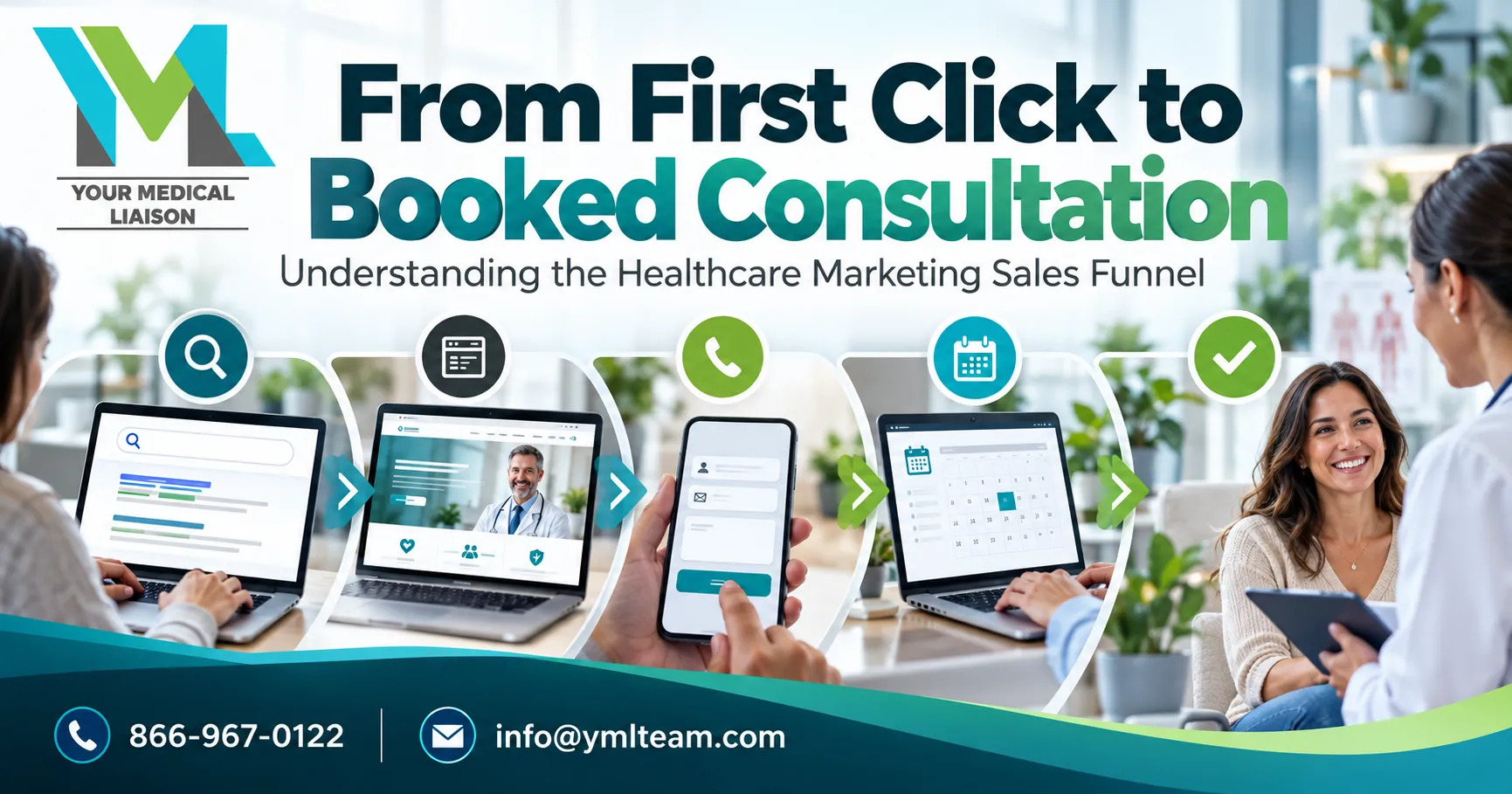
In healthcare marketing services, every patient relationship now starts long before a phone rings or a form gets submitted. It is all because of search engines, social feeds, and online reviews, which have become the new waiting room, quietly helping determine which provider a patient eventually chooses. This is where the healthcare sales funnel comes in handy, as it maps each of these digital touchpoints into a clear, trackable path, turning a curious searcher into a scheduled patient. In fact, a Software Advice survey, cited in a study available through the National Library of Medicine (NIH), found that 71% of patients used online reviews as their first step toward finding a new doctor {1}. But how does that first click actually turn into a booked consultation within the funnel? That’s exactly what we’ll know in this blog. Let’s begin!
Overview: Healthcare Sales Funnel
A healthcare sales funnel guides patients through four stages—awareness, consideration, decision, and booking—turning online searches into confirmed consultations. Trust-building content and easy scheduling reduce drop-off between stages. Within healthcare marketing services, this structured path helps practices convert digital visibility into measurable, booked appointments.
Why Is a Healthcare Sales Funnel Needed Within Healthcare Marketing Services?
Healthcare Decisions Are Emotional
Unlike ordering a product online, choosing a provider involves fear, trust, and long-term well-being. A funnel respects this by giving patients time and information to move from concern to confidence at their own pace.
Builds Trust Before Conversation
Reviews, credentials, and educational content built earlier in the funnel do their work quietly, long before a patient picks up the phone. By the time that first conversation happens, most of the trust-building is already done.
Reduces Drop-Off Between Stages
Somewhere between “researching a symptom” and “booking an appointment,” a lot of patients simply go quiet. Retargeting, timely reminders, and clear next steps are what pull them back before they’re gone for good.
Want a Funnel Built Around Your Patients?
Don’t worry, we design healthcare marketing services that turn first impressions into lasting patient trust.
How Does It Work
Stage 1: First Search, First Impression (Awareness)
This stage covers a patient’s very first digital contact, like a Google search, a social media ad, a local map listing, or an SEO-optimized blog post- the exact channels most marketing healthcare services rely on to build early visibility. It works by matching a practice’s content and location data to what patients actively search for, so optimized keywords and local listings place it directly in front of nearby searchers. In practice, this also means keeping a Google Business Profile updated, maintaining consistent name-address-phone (NAP) info across directories, and using schema markup.
Stage 2: Building Confidence (Interest/Consideration)
Now, once a prospect lands on a website, trust signals do the persuading, such as testimonials, before-and-after results, etc. These work by answering unspoken doubts before a patient even asks them. Behind the scenes, retargeting pixels track that visit, so ads keep reappearing across their browsing, naturally relying on HIPAA-compliant tracking configurations. In short, this stage quietly answers one question: can I trust this practice with my care?
Stage 3: Removing Friction (Decision)
This is where convenience makes or breaks a booking. Through easy online booking, live chat, click-to-call buttons, and clear “book now” buttons, it becomes easy for a patient to say yes. This isn’t just a guess either. In a study published in the National Library of Medicine (NIH) of one ophthalmology practice, the share of appointment slots that were never booked fell from 8.6% to 1.6% after online scheduling was introduced. At this stage, an extra form field or a confusing menu can be enough to lose a patient who was otherwise ready to book.
Stage 4: The Booked Consultation (Action)
This is the funnel’s measurable goal, and it works through automation that closes the loop instantly: confirmation emails and calendar invites lock in the commitment the moment a patient books. Pre-visit instructions sync automatically to their chosen slot, turning an anonymous website visitor into a confirmed name on the practice’s schedule. Indeed, a true payoff of well-executed healthcare marketing services.
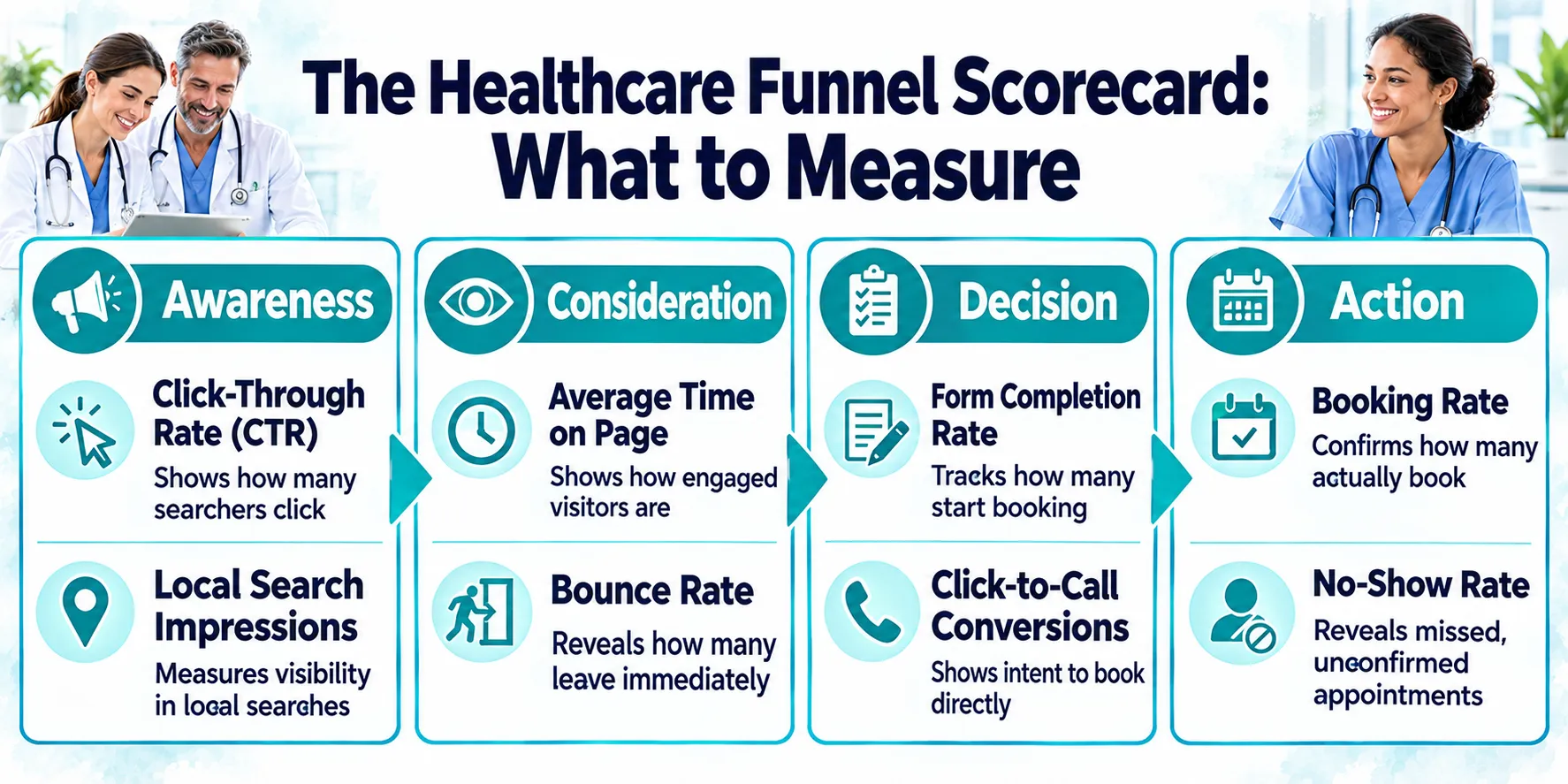
Key Metrics to Track at Each Funnel Stage
Every funnel stage looks different on paper, but numbers are what tell you if it’s actually working. So, you need to track the right metric, as it helps a practice catch problems early, before a slow stage quietly turns into a lost patient. Here’s exactly what to watch at each point in the journey.
Beyond the Booking: Why the Funnel Doesn’t Really End
Just keep in mind that the funnel’s job isn’t finished at booking. Automated reminders, pre-visit instructions, and short educational follow-ups reduce no-shows and prepare patients for their appointment. This practice is also supported by federal guidance, as AHRQ notes that patient reminder and recall systems can reduce missed appointments and increase preventive care visits. {3}
Conclusion
So, now it must be clear that a well-built healthcare sales funnel turns anonymous searchers into loyal, returning patients. This is something no single ad or webpage can accomplish alone in today’s crowded, digital-first healthcare market.
So, are you looking to get this set up for your practice? Your Medical Liaison brings years of hands-on healthcare marketing experience, helping U.S. practices build funnels that turn everyday clicks into confirmed, booked consultations.
Not Sure Where Your Patient Journey Is Losing Momentum?
Talk to our team and pinpoint exactly what’s holding your bookings back.
FAQs- About Healthcare Sales Funnel in Healthcare Marketing Services
How much does a healthcare marketing funnel typically cost to run?
The costs vary by practice size, specialty, location, and channels used, since SEO, ads, and booking software each carry their own different price points.
Can Google Ads alone build a complete healthcare sales funnel?
Not on its own. Paid search can reach patients at every stage, including those actively comparing providers or ready to book. But ads only bring people to the door. Without a trust-building website and an easy booking experience, most paid clicks won’t turn into consultations.
How do practices measure ROI from a healthcare marketing funnel?
By connecting ad spend, website analytics, and booking software data to estimate which channels and content are contributing to completed consultations, not just clicks. Attribution is never perfect, so it works best as a guide for evaluating performance rather than an exact accounting of every dollar.
Should healthcare funnels differ for new patients versus returning patients?
Yes, new patients need more trust-building content upfront, while returning patients respond better to reminders, loyalty touchpoints, and simplified rebooking options.
Which healthcare marketing channels work best at each funnel stage?
SEO and paid search capture intent, educational content builds consideration, retargeting reinforces trust, and optimized booking systems convert interested prospects into appointments.
Why do some doctors’ websites show a “Book Now” button instead of just a phone number?
This is because online booking reduces friction and lets patients schedule instantly, which is why more U.S. practices are replacing phone-only scheduling with self-service booking tools.
Sources:
{1} National Library of Medicine (NIH), PMC: “Millennials Seeking Healthcare: Examining the Degree to Which Patients Utilize Online Resources.”
{2} National Library of Medicine (NIH), PMC: “Efficient Patient Care in the Digital Age: Impact of Online Appointment Scheduling in a Medical Practice and a University Hospital on the ‘No-Show’ Rate.”
{3} Agency for Healthcare Research and Quality (AHRQ): Strategy 6R: Reminder Systems for Immunizations and Preventive Services.
