

A physician introduction opens a conversation, but the next referral depends on what happens afterward. Effective medical field marketing strategies connect that first meeting with practical details: which patients a practice can serve, how appointments are arranged, and where referring offices can get answers. For practice leaders, this means looking beyond visit counts and asking whether outreach makes collaboration easier. A field professional can identify unanswered questions, bring staff concerns back to the right team, and maintain consistent contact as services change. The value lies in turning awareness into a working relationship, without treating clinical referrals as sales transactions. Understanding that distinction helps you evaluate whether your outreach program supports both sustainable practice growth and the needs of referring clinicians.
Overview of Effective Physician Referral Outreach
Effective physician referral networks depend on purposeful outreach, accurate service information, and reliable communication between practices. Medical field marketing professionals engage clinicians and referral coordinators, clarify referral requirements, identify administrative barriers, and route concerns to accountable teams without making clinical decisions. Success should be measured through completed follow-ups, referral progression, and referring office feedback rather than visit counts alone. Compliance safeguards, patient privacy, and clinical independence remain essential throughout.
Connect Outreach to the Referral Experience
A physician referral network is more than a directory of offices that recognize your practice name. For planning purposes, think of it as the relationships and communication pathways through which clinicians connect patients with appropriate services.
Recognition is useful, but the receiving office also needs to be accessible and clear about its capabilities. If a referring team cannot confirm whether a specialist evaluates a particular condition or obtain an update on a submitted referral, another introduction will not resolve the underlying problem.
The Institute for Healthcare Improvement identifies unclear responsibilities, communication breakdowns, and inconsistent requirements as obstacles in specialty referrals. IHI referral guidance emphasizes defined workflows and reliable communication, not awareness alone. [1]
Field professionals can support that work by listening for recurring barriers and bringing them to operational leaders. They should not diagnose patients, determine clinical urgency, or promise access that scheduling teams cannot provide.
Focus your outreach on clinically aligned practices, strengthen communication with referring offices, and make every professional interaction more purposeful.
Make Every Office Visit Useful to the People Receiving It
Rather than beginning with a standard presentation, a field professional should establish what the referring office needs to know. A new specialist, an additional location, or a changed intake process creates a different conversation from a routine introduction.
Useful questions include:
- Which services or referral criteria need clarification?
- What information does the receiving team require before scheduling?
- Who handles referral questions at each office?
- How should staff raise an unresolved administrative issue?
- What updates would be helpful, and how does the office prefer to receive them?
Physician relationship building should include the people who move the process forward: referral coordinators, office managers, and other appropriate staff, as well as clinicians. The physician may choose the clinical destination while staff manages the documents, scheduling questions, and follow-up communication.
Respecting those roles makes outreach more relevant. A concise, accurate referral guide can be more useful than a broad brochure when a coordinator needs to know which records to send.
Explain Clinical Fit Without Making Clinical Decisions
B2B healthcare marketing needs to communicate more than a list of services. Referring clinicians need an accurate understanding of the receiving practice’s scope, limitations, and access arrangements.
A field professional can help maintain clinician-approved materials covering conditions evaluated, available services, locations, accepted coverage information, and contact pathways. Details that change frequently should have an owner and a review process. Insurance participation and appointment availability should be verified rather than presented as permanent promises.
For example, when a practice adds a specialist, outreach should clarify the services actually available and the correct referral route. It should not imply that every patient within that specialty will be suitable.
Clear information supports informed collaboration. Decisions about medical necessity, urgency, and the appropriate clinician remain with qualified clinical teams.
Turn Feedback Into an Assigned Next Step
Consider a hypothetical situation: a referring office reports sending records twice without knowing whether they arrived. A field representative could respond with another brochure, or document the administrative concern, identify the intake lead, and arrange follow-up through an approved process.
The second approach gives the conversation a practical purpose. It also prevents the representative from making assurances before the problem has been checked.
A useful follow-up record should capture the issue, its owner, the agreed next action, and when an update is expected. Keep business relationship notes separate from patient-level information unless the system and access are specifically approved for that purpose.
If your outreach team is active but the same concerns keep returning, review how feedback reaches operations before increasing the number of visits. A relationship cannot compensate indefinitely for an unresolved service problem.
Support Closed-Loop Communication Without Taking Over Care Coordination
Closed-loop referral management means that relevant information reaches the right people, receives appropriate action, and is acknowledged and documented. IHI’s framework includes tracking the referral through consultation and communicating the resulting information back to the referring clinician. [1]
Marketing professionals can help identify where an office lacks a reliable contact or where instructions are unclear. Clinical and referral-management teams remain responsible for the patient-specific workflow.
That distinction matters when setting expectations. A field professional should not be presented as the person who interprets results or decides what happens after a missed appointment. Instead, the role can help offices understand the approved escalation route and report recurring communication barriers to the responsible team.
Technology is only part of the solution. IHI process recommendations also emphasize standard processes, accountability, and communication between the teams involved. [2]
Measure Progress Beyond Meetings and Referral Volume
The strongest evaluation of medical field marketing strategies separates activity from operational progress. Office visits show that outreach occurred; they do not establish that the relationship became more useful or that patients reached appropriate care.
Consider a balanced scorecard:
| Measure | What it helps you examine | Important limitation |
| Relevant offices reached | Whether outreach matches the practice’s clinical scope and service area | Contact alone does not demonstrate trust |
| Follow-up commitments completed | Whether the team delivers on agreed actions | Completion should include an appropriate resolution, not just a closed task |
| Repeated administrative concerns | Whether the same barriers remain unresolved | Reporting may rise initially as communication improves |
| Referral-to-appointment progression | Where referrals stop moving through the approved workflow | Scheduling, patient choice, coverage, and capacity also affect progression |
| Referring-office feedback | Whether information and contact routes are useful | Feedback should be assessed alongside operational evidence |
Use consistent definitions and comparable reporting periods. A change in referral volume may reflect staffing, service availability, seasonality, or other factors. Do not attribute every increase to outreach or every decrease to weak relationships.
Keep Growth Efforts Within Clear Compliance Boundaries
Relationship development must not become an exchange of value for referrals. HHS Office of Inspector General guidance explains that the federal Anti-Kickback Statute prohibits knowingly and willfully offering, paying, soliciting, or receiving remuneration to induce or reward referrals involving federally reimbursable services. Remuneration can include more than cash. [3]
Have qualified compliance or legal advisers review compensation arrangements, gifts, meals, sponsored activities, and other arrangements involving potential referral sources. A professional label or educational purpose does not by itself establish that an arrangement is permissible. OIG notes that even fair-market-value arrangements can require fact-specific assessment. [4]
Separately, establish approved information-sharing channels and role-based access. Business outreach records should not become an informal repository for patient records.
The goal is to communicate capabilities and improve professional collaboration while preserving clinical independence and patient choice. This discussion is educational, not legal advice.
Build a Program That Offices Can Rely On
Sustainable referral network development connects purposeful outreach with accurate information, dependable follow-up, and operational accountability. It is not simply a campaign to generate more introductions.
Before expanding your program, assess whether the people responsible for outreach can explain your services accurately, route questions correctly, and demonstrate that promised follow-up occurred. When evaluating a professional partner, ask to see that working process, not just a calendar of planned visits.
Begin with a review of your current referral pathway and the questions referring offices repeatedly raise. That gives the next relationship-building effort a practical purpose and a clearer standard for success.
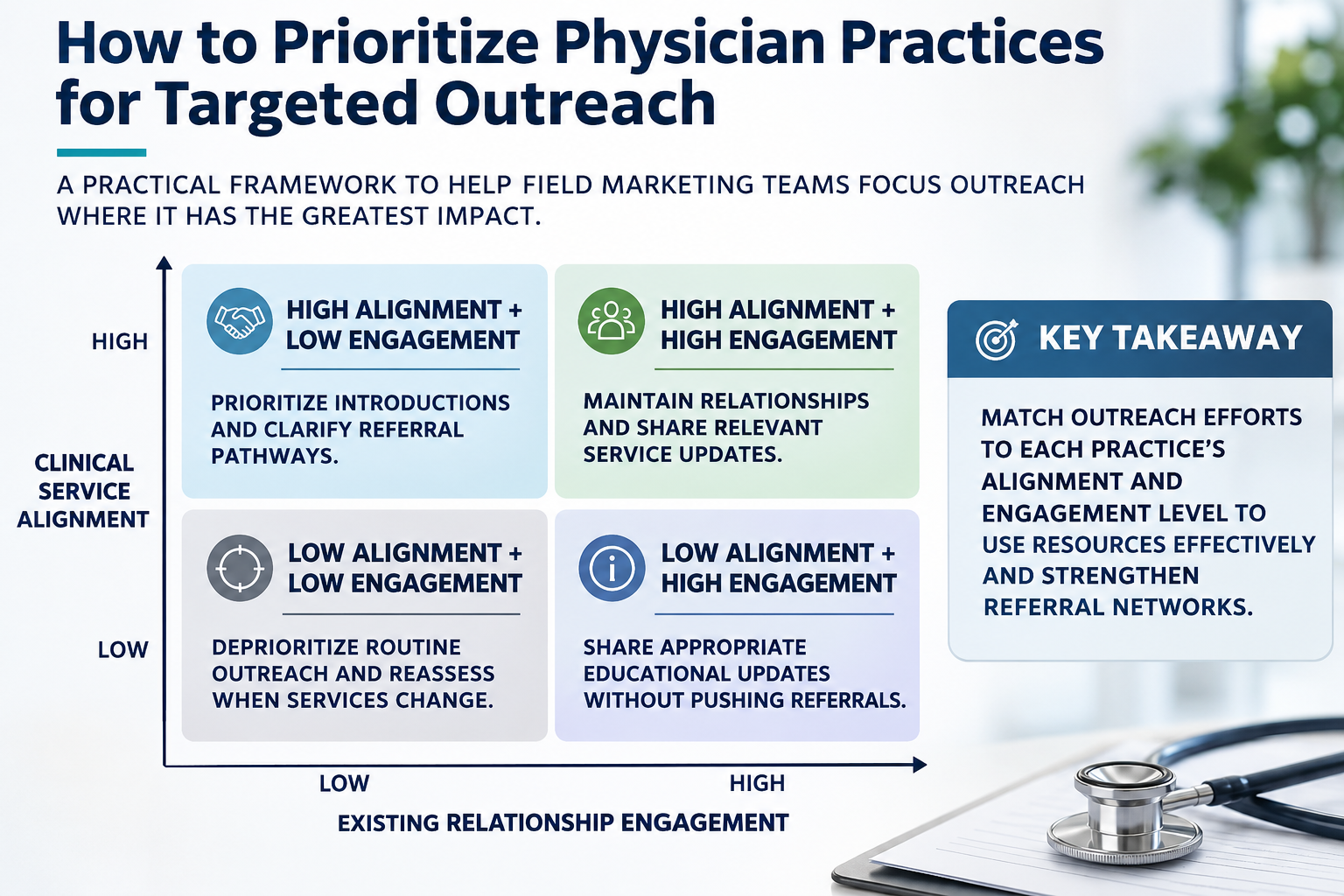
How to Prioritize Physician Practices for Targeted Outreach
Prioritizing physician outreach requires evaluating both clinical service alignment and existing relationship engagement. This matrix helps medical field marketing teams identify high-priority practices, strengthen established connections, provide relevant educational updates, and allocate outreach resources effectively to support sustainable physician referral networks.
Conclusion
Strong physician referral networks are built through consistent communication, accurate service information, and follow-through that referring offices can trust. Prioritizing clinically aligned practices, addressing administrative concerns, and respecting compliance boundaries makes outreach more useful for everyone involved. Your Medical Liaison helps practices approach physician relationship-building with greater structure and purpose, connecting outreach efforts with the practical needs of referral partners while keeping patient care decisions firmly where they belong.
From targeted practice outreach to ongoing relationship management, Your Medical Liaison helps healthcare practices develop meaningful connections with referring professionals.
Frequently Asked Questions
How Is Field Outreach Different From Digital Promotion?
Digital promotion distributes information through channels such as search, email, and a practice’s site. Field outreach adds direct conversations with referring offices and a route for bringing their questions back to the practice. The two should use consistent, verified information.
Can Field Professionals Guarantee More Referrals?
No. Clinical appropriateness, patient preference, access, coverage, and practice capacity all influence referral decisions. Evaluate the work through relevant engagement, completed follow-up, and operational progress rather than a volume guarantee.
Should the Team Focus Only on Physicians?
No. Include the appropriate administrative and referral-management contacts while respecting each person’s responsibilities. Their practical questions can reveal problems that a physician introduction alone would miss.
Does the Representative Need Access to Patient Records?
Not automatically. Define access around the actual job responsibilities, applicable requirements, and organizational approval. General relationship management should not be treated as permission to collect patient-level details.
Sources
[1] Institute for Healthcare Improvement (IHI). Closing the Loop: A Guide to Safer Ambulatory Referrals in the EHR Era.
[2] Institute for Healthcare Improvement (IHI). Improve the Referral Process, Improve Safety.
[3] U.S. Department of Health and Human Services, Office of Inspector General (HHS-OIG). Fraud & Abuse Laws.
[4] U.S. Department of Health and Human Services, Office of Inspector General (HHS-OIG). General Questions Regarding Certain Fraud and Abuse Authorities.
