
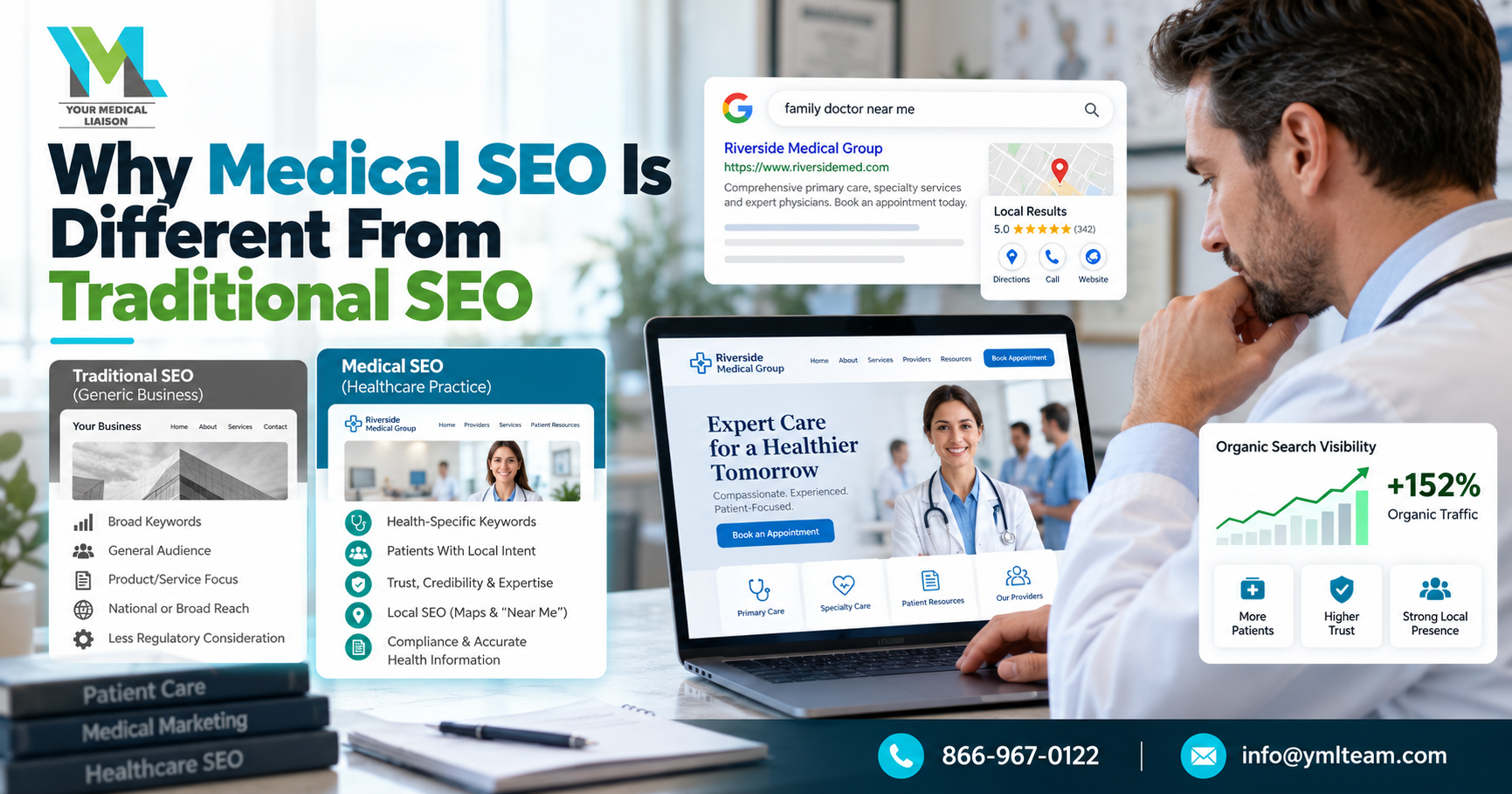
Patients searching for medical conditions, diagnostic services, treatment options, or specialists need content that clearly and accurately addresses their concerns. Therefore, healthcare providers must consider how search engines discover and rank their pages so patients can evaluate the authority and reliability of the information presented. Medical SEO marketing addresses these needs by emphasizing health-specific search intent, trustworthy content, and a website experience that makes essential information easy to find.
But why does medical SEO require a different approach than traditional SEO? Understanding these distinctions helps healthcare organizations develop effective medical SEO strategies that improve relevant search visibility while maintaining patient trust. This guide explores the key factors that make functional and integrative medicine SEO different from traditional SEO and explains why healthcare websites require a more specialized approach to search optimization.
Insight On Medical SEO: Key Differences and Essentials
Medical SEO requires a specialized approach because healthcare content influences decisions about symptoms, diagnoses, and treatments. Unlike traditional SEO, it prioritizes clinical accuracy, evidence-backed claims, credibility signals such as qualified authorship and expert review, verified provider credentials, and regularly updated information. Effective strategies align keywords with patient intent, provide relevant local service details, and use appropriate medical schema. Healthcare organizations must also address HIPAA, where applicable, and other relevant privacy and advertising rules while optimizing content for AI search visibility, citations, and trustworthy answers.
What Makes Medical SEO Different From Traditional SEO?
Medical content falls under Google’s YMYL scrutiny
Google classifies topics that can significantly affect a person’s health, safety, or financial stability as Your Money or Your Life (YMYL). Google’s Creating helpful, reliable, people-first content guidance explains how qualities associated with experience, expertise, authoritativeness, and trustworthiness (E-E-A-T) can help readers evaluate content, particularly on topics that could affect health, safety, or financial stability. E-E-A-T is not itself a single Google ranking factor.
Medical claims require scientific substantiation, not just persuasive copy
In traditional commercial SEO, a business can describe verifiable product features, explain its service process, and highlight customer benefits. Healthcare content often makes claims about treatment effectiveness, risks, contraindications, or clinical outcomes, which require a different level of scrutiny. The U.S. Federal Trade Commission’s Health Products Compliance Guidance states that health-related advertising claims must be truthful, non-misleading, and adequately supported by scientific evidence. The appropriate evidence depends on the claim, and testimonials alone do not establish treatment effectiveness.
Author expertise and medical review have a different purpose
Both traditional and medical websites benefit from transparent authorship. However, in healthcare, the author’s qualifications and the review process can help readers judge whether clinical information has been prepared or checked by someone suitably qualified. Google recommends making authorship clear where readers would reasonably expect it, with bylines that lead to relevant information about the content creator.
Medical Keywords Require Greater Clinical Precision
Medical keyword research requires understanding not only what a patient searches for, but also what they need to know at that stage of their healthcare journey and how the information may influence their next decision. Effective medical practice search engine optimization accounts for searches about general symptoms, possible causes, diagnosis, treatment effectiveness, safety concerns, and access to a qualified clinician. Each intent requires a different content response.
Provider Credentials and Services Must Be Verifiable
A medical website should accurately represent each clinician’s specialty, qualifications, licensing status where applicable, and actual scope of practice. Service pages must not imply that a practitioner performs procedures they are not qualified or equipped to provide. This makes credential verification and consistency between provider profiles and service descriptions particularly important.
Medical Information Needs Ongoing Review
Clinical guidance, screening recommendations, approved treatments, and medication information can change. Medical SEO therefore needs a review process that identifies outdated claims, checks current authoritative guidance, and updates affected pages. A visible review date is useful only when supported by a genuine review, not merely a changed publication timestamp. This ongoing work should form part of a broader medical SEO marketing strategy rather than being treated as an occasional website maintenance task.
Need an SEO strategy built for a functional or integrative practice? Your Medical Liaison helps MDs and DOs improve online visibility while taking day-to-day marketing management off their plates.
How Do E-E-A-T and Medical Compliance Change the Content Approach?
- Credentialed authors and clinical reviewers: For clinically sensitive content, identify appropriately qualified authors and use expert review where warranted. These practices help readers assess credibility; E-E-A-T is not itself a single Google ranking factor. Clear bylines linked to author information, together with review of treatment mechanisms, contraindications, and clinical recommendations, show readers who is accountable for the medical information.
- Documented medical review dates: Medical content requires a review process that responds to changes in clinical guidelines, prescribing information, and safety evidence. Rather than updating dates simply to make pages appear fresh, healthcare websites should reassess the recommendations and claims that may have become outdated.
- Patient privacy and tracking compliance: Privacy requirements shape what a medical website can collect, how forms are designed, and how enquiries are measured. HIPAA, where applicable, and other relevant privacy laws depend on whether the organization is a covered entity or business associate and on the data involved. Analytics and advertising pixels can create additional privacy risks, as the HHS guidance on online tracking technologies explains. Patient enquiries, booking events, and attribution must be measured using privacy-appropriate tracking, vendor arrangements (such as business associate agreements where required), and consent or authorization where required. Patient-level conversion data should not be assumed safe to send to advertising platforms.
Why Must Medical SEO Also Be Optimized for AI Search (GEO)?
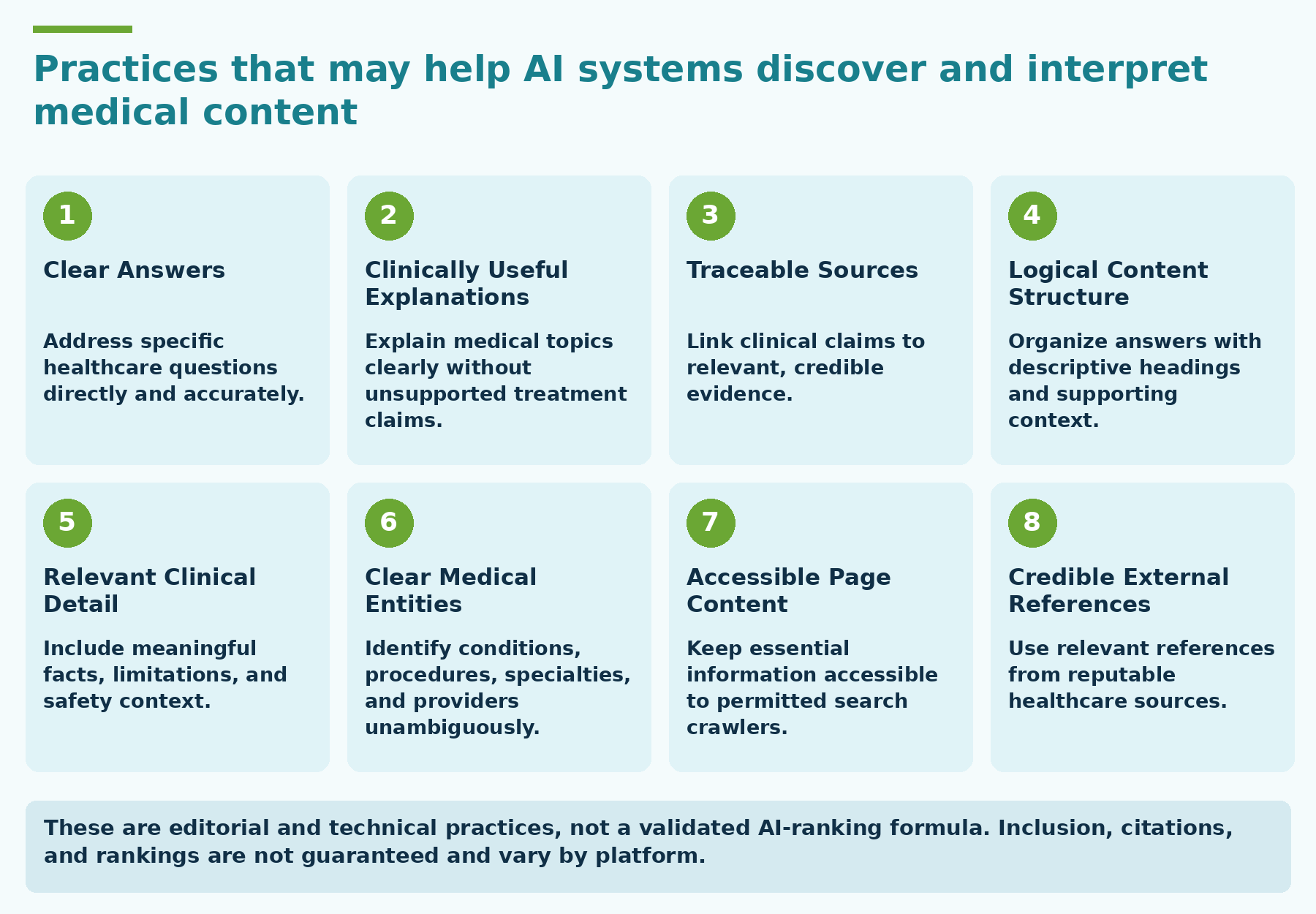
For medical practices, AI search creates another opportunity to reach patients researching symptoms, comparing treatment options, or looking for healthcare providers. Optimizing for generative engine optimization (GEO) means making medical content easy for AI systems to discover, interpret, and reference through clear answers, specific clinical facts, accessible page content, and credible sources. The infographic below discusses key factors that help to improve medical SEO for AI search.
How Does Patient Search Intent Make Medical SEO Different?
Patients Search for Symptoms Before They Know Which Specialist to Consult
Unlike many commercial searches, healthcare searches often begin with a symptom rather than a specific service. Someone with recurring headaches may search for possible causes before knowing whether to see a general practitioner or a neurologist. Medical SEO must therefore address early-stage questions with accurate, evidence-based content that explains potential causes and when professional evaluation may be appropriate, without attempting to diagnose the reader.
Treatment-Related Searches Require Detailed, Medically Accurate Information
Patients researching procedures or treatments often want to understand how an option works, who may be eligible, its potential benefits and risks, and what to expect during recovery. Medical SEO requires dedicated treatment pages that answer these questions clearly with reliable medical evidence and avoid unsupported promises.
Local Search Intent Helps Patients Find Accessible Healthcare Providers
Queries such as “dentist near me” or “orthopedic specialist in [city]” indicate that a patient is looking for a provider in a particular location. Thus, medical practices need accurate location pages, consistent contact information, and a complete, relevant Google Business Profile to support local discovery. These elements help patients verify where a practice operates, what services it offers, and how to arrange an appointment.
Medical Schema Helps Search Engines Understand Practice and Service Information
Patients may search for a particular specialty, clinic, or healthcare service, so search engines need to interpret the information published on medical websites. Relevant structured data, such as MedicalClinic, Physician, or LocalBusiness where appropriate, can describe a practice and its details. Thus, Schema must accurately reflect visible page content to support search engine understanding.
Conclusion
Functional and integrative medicine physicians need more than isolated tactics to compete online. Your Medical Liaison is a trusted, full-service healthcare marketing partner that provides end-to-end oversight of medical SEO, local search, content, and AI-focused search strategies. This helps maximize marketing ROI and return time to physicians by reducing the workload of managing multiple channels. Start with a medical marketing checkup.
Ready to grow your functional or integrative practice and get time back? Talk with a full-service partner focused on maximizing marketing ROI.
Frequently Asked Questions On Medical SEO Requirements
How can I measure the return on investment from medical SEO?
Track organic enquiries, qualified leads, booked appointments, patient acquisition costs, and revenue attributable to organic search, using privacy-appropriate measurement. HIPAA, where applicable, and other relevant privacy laws may limit what can be tracked and shared, so set up tracking, vendor arrangements, and consent or authorization with qualified privacy or legal advice. Do not send patient-level appointment or conversion data to advertising platforms unless this has been confirmed as permissible.
Can medical SEO help a new clinic compete with established practices?
Yes. Focus on specific services, achievable local markets, and relevant patient needs. Build visibility progressively instead of targeting every competitive keyword immediately.
Should every medical specialty have a separate SEO strategy?
Yes. Specialty-specific strategies reflect differences in patient demand, service offerings, competition, appointment pathways, and the commercial priorities of each department.
How often should a medical practice review its SEO performance?
Review core performance monthly and conduct deeper strategic assessments quarterly. Investigate significant traffic changes promptly rather than waiting for scheduled reporting.
What should doctors look for when choosing a medical SEO agency?
Assess healthcare-sector experience, transparent reporting, realistic commitments, clear deliverables, conversion measurement, and the agency’s ability to explain its strategy in practical terms.
